Weed Warriors: 25 Awesome Tips for Battling Plants You’d Rather See Less Of
Oh my goodness, things are really starting to heat up in the vegetable garden! The warmer weather brings a flush of growth to our veggies but it also spurs the weeds into action, so we are on the warpath to keep them under control.
Here are a few tips you may find helpful as you battle the bindweed and fight off the fat hen!
Please note: There are some product mentions in this article, these are things we use and recommend. Some of the links are amazon links and we earn a small commission from Amazon (at no extra cost to you) if you make a purchase after clicking on them.
#1 Attack Early, Attack Often
My husband has a saying “hoe before you see a weed, and you’ll never see a weed”. And this is a philosophy I fully subscribe to in theory, even if I don’t always succeed in practice.
Weeding early is so worthwhile because weeds are far easier to remove when they are small and the roots are still superficial. If you are disciplined enough and have time weeding daily or every other day makes life easier.
And the more often you do it, the less of a big deal it seems.
#2 Weed Wet – After Rain Or Watering
Moist soil makes it easier to get those stubborn roots out. But if you are hoeing, make sure more rain isn’t on the horizon.
If it rains after you hoe, it’ll help the loose weeds re-attach! Not good!

#3 Know Your Enemy
Get the lowdown on your main competitors! Weeds are competing with your precious plants for water and nutrients. And they are specific to your region and even to your exact property.
The more you know about them, the better. Some are more resistant to hoeing for example, and the more difficult and persistent your local weeds are, the faster you need to act.
I use an app called ‘Picture This’ to identify everything that grows on our homestead. And there are always some surprises there. It’s one of the few apps I am happy to pay for, and it’s extremely fast and accurate.
#4 Mulch Mulch Mulch
There are lots of ways to mulch around plants, including dry leaves, grass clippings, straw or hay, wood chips, cocoa shells etc.
Some of them have risks, cocoa shells for example can make dogs very sick if they eat them. And wood chips can deplete the soil of nitrogen as they use it to break down.
But straw, leaves and grass clippings can all help keep your plant’s roots cool and moist, as well as smothering all but the most determined weeds and weed seeds.
Better still, you can get two birds with one stone, and feed as you mulch, using that lovely home-made compost you prepared earlier!
Mulch is a temporary solution as weeds will colonise it eventually. But it can definitely be an ally and will help your plants cope better with intense heat.
#5 Pamper Your Soil With Paper
Thick layers of newspaper or cardboard can make a great barrier to weeds. You can lay this on the ground and transplant through holes that you cut into it. Or if you have already planted out, you can lay rows of it either side of the stems.
Steer clear of cardboard or paper with a glossy surface or bright colors as these don’t tend to rot down as well.
You can put mulch on top of it to improve the appearance, but I find that tends to attract more weeds eventually
The downside? Well I’ve got to be honest, this is not my favorite method because I like my veggie plot to look pretty. And cardboard just isn’t that. But if you don’t mind the way it looks, and plenty of people don’t, then it’s definitely worth a try.
#6 Harness The Sun’s Rays
A great way to kill weeds if you are in a sunny zone is with solarization. It simply means laying a clear plastic sheet over a piece of ground and literally cooking the weeds underneath.
Solarization has the added benefit of cooking germs too, and may help to reduce pathogens in your vegetable patch.
For best results, cook your patch for several weeks. Obviously, you need to think ahead to use this method, but it might be one to bear in mind for next year!
#7 Use The Dark Side
A more popular method that works in any climate is suppressing light. Also known as occultation or tarping. Though you don’t need a tarp. You can buy heavy duty garden cloth online in various sizes. But any dark layer that deprives weeds of sunlight for weeks on end will do the trick.
Thick opaque plastic sheeting and cardboard can be used too, with the added benefit that cardboard eventually rots down.
#8 Water Management Tactics
When the weather is warm and dry, it’s fairly common for people to give a little water to their vegetable plot or flower beds, each day. The problem with this approach is that the weeds benefit from that water too.
One way of helping those veggies while depriving the weeds of water is to soak the soil much more thoroughly then leave it for a few days. The top layers dry out to the detriment of shallow rooting weeds. While the more established vegetables have deeper roots and are able to draw their moisture from lower down.
Also known as deep watering, this method has the benefit of encouraging your established plants to root more deeply.
The downside is that it’s not sufficient for your newly transplanted seedlings which need that daily water until they are established. So its a method that requires a little judgement on your part
#9 Spot Weeding
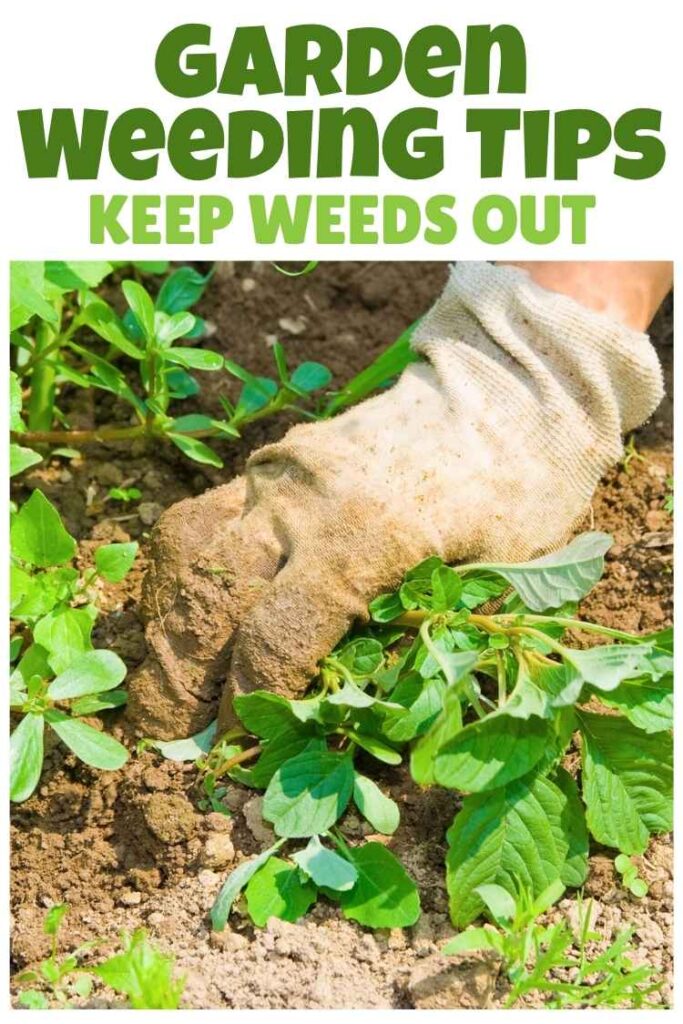
Not all weeds grow conveniently in-between rows. Sometimes weeds get themselves embedded right between the individual plants, even wrapped around their stems.
When this happens, then usually the only answer is to get down on your hands and knees and pull the weeds out with your fingers.
This is when a decent pair of gardening gloves comes in really handy. I’m quite picky about my gardening gloves and I don’t like wearing them when they get gritty inside.
If you are the same, my extra tip is to keep yours safe where other family members don’t use them (and lose them)
#10 Have The Right Tools Ready
In addition to keeping tabs on your gloves, it’s a good idea to have a special place to keep your gardening tools and be disciplined about putting them away at the end of each day.
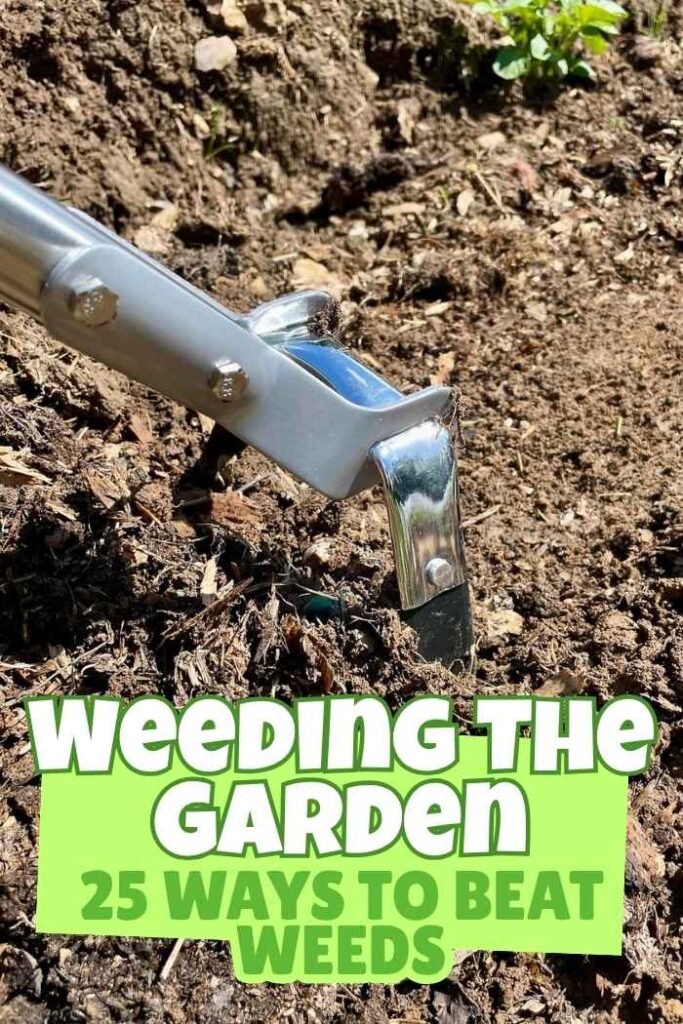
My most important tool for weed control is my hoe.
I prefer a Dutch hoe that you push forwards to a drag hoe. I just find the Dutch hoe easier to use. I’ve heard some good things about oscillating stirrup hoes, but I haven’t used one yet. There are also some very specific weeding tools you can buy. We’ll look at those next
#11 Try A Taproot Weeder
We have a lot of dandelions here, which my rabbits love to eat, including the roots. And a taproot weeder is a great way of levering dandelions and other deeprooting weeds out of their hiding places.
The tool looks like something you might need for a barbecue, a long spike with small forked tip. But they are really useful in the garden.
They are great for wrestling thistles out of grass in pony paddocks too!
#12 Try a Hori Hori Knife
These cunning tools are a cross between a long gardening trowel, and a sheath knife. And a Hori Hori knife is a brilliant tool for getting stubborn weeds out of tight spaces.
They are sharp so need to be kept out of reach of children, and they usually come with a sheath to keep the cutting edge away from fingers.
#13 Squeeze The Weeds Out!
Planting your borders or crops closely to minimize bare soil is a great way to crowd out those unwanted weedy visitors!
There are some great ground cover plants that look very pretty in between shrubs and larger perennials, so make good use of those, and don’t give the weeds a chance to get their feet under the table!
#14 Plant Cover Crops Or Catch Crops In Empty Spaces
Still on the theme of avoiding open spaces, cover crops are a great way to prevent weeds getting a hold. And if you are in between main crops in vegetable patch, make sure to plant fast growing catch crops like lettuce in any temporary gaps.
Not only does this reduce space for weeds, you are more likely to care of those that do appear, if you have other plants that need attention in the space.
It might seem that it doesn’t matter if an empty bed gets a bit weedy, but actually those weeds will set seed faster than you can say “where’s my hoe” and spread to other beds before you know it.
#15 Don’t Let Weeds Set Seed
Do everything in your power to prevent weeds from setting seed. If you can see flowers on your weeds you are almost too late. You need to act fast.
Remember that a single weed plant can cast thousands of seeds into the wind to do their worst around your garden.
#16 Try To Avoid Tilling Dry Soil
Another way to avoid spreading seeds is to avoid tilling the soil unless it’s nice and moist. Every time you till, you risk bringing dormant seeds to the surface and triggering a new flush of weed growth. A lot of people avoid tilling at all nowadays and there’s a lot to be said for no till gardening.
#17 Upping Your Edge Control!
My Grandad had a wonderful array of edging tools to keep his lawns, borders and vegetable beds looking neat and tidy. Including an interesting half moon shaped one, and various other devices such as edging shears for maintaining control! All scarily sharp and polished within an inch of their lives at the end of each day.
That was back in the day, and in our busy modern world, you don’t see many people fussing over their ‘edges’ any more.
But there’s more to neat edges than just keeping up with the Jones’s. A decent lawn edger can help with weed control too and will help prevent the spread of those cheeky weeds into your prize petunias. So if you have the time and the inclination….
#18 Hot Water Treatment
For a quick, spot-on, treatment for those pesky weeds that get in-between the cracks of your paving stones, a simple dose of boiling water can work well.
I’m sure I don’t need to tell you not to do this when your children or grandchildren are around. Or warn you to be careful when carrying boiling water. But I’ll say it anyway.
Weeds don’t like boiling water, but neither will your toes. So take care.
#19 Break Out The Vinegar!
You may (or may not) be surprised to know that some people swear by vinegar as an alternative to herbicides.
You can buy horticultural vinegar for this purpose. Mix it with salt for a double whammy. Grab a cheap plant spray bottle and mix two pints of vinegar with quarter cup of salt and a teaspoon of dish soap for a home made, herbicide free, weedkiller.
But remember, just because it’s ‘natural’ doesn’t mean it’s harmless. If you get this on your favorite plants, they’ll die too!
#20 Flame Weeding!
Oh wow, we’re really getting adventurous now, but, used with extreme caution, a flame weeder can be a useful tool. These are a kind of long handled blowtorch like device that run on propane gas. We’re looking at small patches of weeds in large areas of gravel or paving here.
Do not (obviously) use it near your house, garage, outbuilding etc. Do not use near any flammable substances, in windy weather, or in areas where there is a fire risk of any kind.
Don’t use during a heatwave or long dry spell, and only use in the presence of responsible adults. And always have a running water supply ready and reachable
#21 Herbicides: Be Careful With The Big Guns
We have herbicides now that are capable of targeting broad leaved plants (dicotyledons) only. They can be sprayed onto grass because grasses belong to a group of plants (monocotyledons) that are not susceptible to them.
Some lawn purists are very fond of these herbicides. But be careful what you wish for. Plants like clover are very beneficial to grass. They are nitrogen fixing and improve the soil.
For that reason and because we graze animals on our grass that benefit from plants like clover, I am not a fan of treating grass with herbicides that kill all the broad leaved plants growing among them.
We’re not fanatical about not using chemicals and will sometimes spot treat patches of weeds that are damaging to pasture. But I must confess that spraying an entire area with a broad leaved herbicide seems a bit like vandalism to me!
#22 Check Your Mower Height!
Your best ally against weeds in your grass is your mower. Broad leaved plants in general do not like being cut down in their prime.
But, if you mow too close, you may find that the tougher, low lying weeds and the moss that nobody wants in their lawn, starts to flourish.
A little bit of height in thick grass helps to shade out the weeds and reduce germination of their seeds. You may have to experiment a little to get this right. But in general, mowing at a high setting, is a good way to keep weeds at bay.
We have sheep instead of mowers, and unfortunately they are a bit more selective than your mower blades, so we still need to do a little spot weeding!
#23 Clean Those Tools
My Grandad’s obsession with keeping his tools clean wasn’t so silly. It actually had a practical purpose. Weed seeds stick to dirty hoes and spades and are then transported around your garden.
A quick spray with the hose and rub down with an old cloth will keep them clean during the summer months. In the winter a wipe of oil helps keep metal tools in good shape.
#24 Your Dedicated Weed Bucket
Keeping a bucket just for weeds is another good idea. I like a brightly colored one. I also have a white bucket for edible weeds and garden trimmings, and these go into my rabbit pen.
If you are able to keep your compost pile running nice and hot (see hot vs cold composting) your weed seeds will be destroyed during the composting process.
#25 Finally – Write It Down
I love keeping written records. I keep an ‘events’ spreadsheet for my homestead. Here we write down when sheep are sheared and vaccinated, when parsnips are sown and garlic harvested. And all the other goings on in the vegetable patch
A gardening notebook with these little snippets of information can be fascinating to look back on. Any major weed prevention measures such as tarping or flame weeding can be written in here with the date, and you’ll find it much easier to figure out what worked, and what didn’t.
Modern Weed Control
Gardeners on the whole are great conservationists and have taken their role as protectors of the environment to heart. I think that’s a wonderful thing.
Gone is the emphasis on chemical control.
Nowadays we are all more focused on preserving our awesome planet, and your little corner of it is one more contribution to the team effort. Because what you do in that corner really matters.
So, I hope you find these natural and thoughtful tips on weed control helpful. And that they support you in your efforts to keep your garden a beautiful and bountiful place to work and play.