How To Keep Your Calatheas Alive – Calathea Care Tips
If you are anything like me and have watched in frustration as yet another Calathea gives up the struggle for life and withers before your eyes, don’t despair. Your dreams of Calathea competence can come true!

It took me a couple of years to master the art of keeping Calatheas happy. But you don’t need to wait that long. I’m going to share the do’s and don’ts, and Calathea plant care tips, that finally helped me succeed. This is your Calathea Cheat Sheet.
Making Your Calatheas Happy

Why do my Calatheas keep dying?
The essence of Calathea survival lies in finding a compromise between the humid jungle conditions that Calatheas really long for. And the realities of living in a house designed for humans, not tropical plants.
Reaching the right compromise is challenging. But it can be done.
Many Calatheas die because they are too dry…
…Or too wet (yep, you don’t get off lightly)!
They also don’t like being pot bound and if the conditions aren’t right for them, they are prone to spider mites that will kill them if you let the infestation get too bad. And they don’t appreciate low temperatures. Let’s tackle these one at a time.
Getting the location right
Calatheas will not thrive in front of a hot, south facing window. Yes they like higher temperatures, but they are essentially jungle floor plants and dappled sunlight is more their thing.
I keep my Calatheas on the east side of my north facing (heated) conservatory. So they get plenty of light and warmth, but not much in the way of direct sunshine, apart from first thing in the morning when the sun is not too strong.

I save the west facing windows for my more sun tolerant plants as the afternoon sunshine is much more intense.
In zones where winter temperatures drop below freezing you must keep your Calatheas in a well heated room, and you may need to move them away from windows at night to avoid them getting chilled when the heating goes off for a few hours. Forgetting about the night time lows in our conservatory was one of my first mistakes. It doesn’t need to be yours. At least not from now on!
Getting the humidity right
People will tell you that Calatheas are jungle plants that crave humidity, and they do! They’ll also tell you that your Calathea would be happier in the bathroom. And it would!
In fact, if you really want one to be happy, plant it in a terrarium with an automatic mister and maintain a humidity level of over 70%. Your Calathea will be eternally grateful.
But here’s the thing. Whenever someone tells me that this plant, or that one, would be happier in my bathroom, I tell them that the majority of my plants would be happier in my bathroom!
And there definitely isn’t room in there for all of them.
And the truth is, while I love my plants, I don’t buy them just to keep them happy. I buy them and care for them because they decorate my home and make it a nicer place to be.
If I put them all in the bathroom, that rather defeats the object of keeping plants and going to the trouble of looking after them.
So, how do you get the humidity right for Calatheas without turning your home into a sauna? I use several methods including:
- Pebble trays
- Misting
- Moss
- Grouping
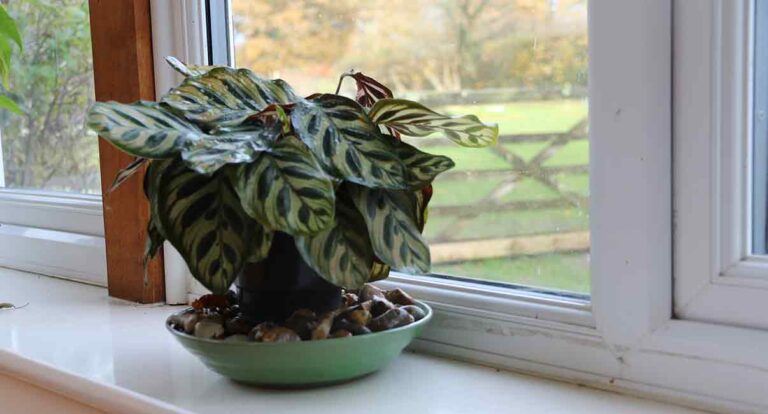
Pebble trays: Standing a Calathea pot on a pebble tray, with water in, helps. I don’t do this for all of them. But it seems to be a good pick-me-up if a Calathea starts to get downhearted.
Misting: I also keep a plant mister next to the plants so that every time I go past, I am encouraged to give the soil around the base of the leaves a gentle spray.
Moss: If you add some sphagnum moss to this soil, that will help to store moisture and maintain a humid environment around the base of the leaves
Grouping: Airflow reduces humidity by allowing the moisture to evaporate and disperse. So placing two or three calatheas together in a group helps to maintain the humidity levels within it.
Obviously its important that the plants in the group are all healthy when you do this (see spider mites below)
You can read more about tweaking humidity levels in this article: Getting The Humidity Right For Your Plants
Remember, none of these is a perfect solution. Your Calathea would still prefer the terrarium. But hey, we can’t always have everything we want right?
Overwatering and Underwatering
In the early days, I killed a couple of Calatheas by overwatering them. All the information I read said they must always be moist, but it turns out that even Calatheas can have too much of a good thing.
It isn’t easy to win this watering game! In fact, I think its one of the hardest things to get right with many house plants.
You can buy a humidity probe that you poke into the soil and that tells you whether or not the soil is damp enough. These actually work quite well and I used mine for a while until I felt more confident about how much water to give my plants.
I find with Calatheas, little and often is best. So I get into a routine of watering at the same time each day, and just adding a small puddle of water around the base of the leaves.
Your Calatheas shouldn’t be sitting with their roots permanently in water. So unless your pot is standing on a pebble tray, check every now and then that your plant pot holder isn’t filling up with liquid. Lift the inner pot right out to make sure.
Chlorine Free Water
It turns out jungle water isn’t chlorinated! And the type of water you give your Calatheas is important.
It isn’t only calatheas that hate chlorine, so I don’t use water straight from the tap for any of my houseplants. Instead I fill a large jug once a day and leave it on the kitchen window sill to stand.
The next day at around the same time, I tip it into my houseplant watering can and refill the jug for the following day. Initially, you may have to police other members of the family who use it to fill the dog’s water bowl, or the kettle etc…
It takes around 24 hours for most of the chlorine to dissipate from the water that’s left out to stand in this way, and while it may not be completely chlorine free, it seems to be good enough to keep most plants happy.
If your Calatheas are still unhappy with tap water that has been left to stand for 24 hours, you could also try switching to distilled water.
Cleaning Your Calathea’s Leaves
This is a recent addition to my Calathea care routine. I moisten some kitchen towel with the same water I use to water the plant. And wipe down each leaf to remove dust and debris.

There is a school of thought that says plants do not like their leaves being handled. But as we have a lot of dogs and the dust levels in our home are quite high, I thought that the benefits might outweigh any disadvantages. And so far the plants seem to be happy with this treatment.
Wiping the leaves down makes them look much prettier. It’s also very satisfying to look at your paper towel and see how much dust you’ve removed.. Depending on your home this can be a surprisingly large amount.
Dealing With Spider Mites
Calatheas are susceptible to these pesky bugs. Sometimes they come in on a new plant, other times they just seem to appear from nowhere.
Spider mites are not always easy to spot until they have got their feet firmly under the table.
I’ve tried a number of ways to get rid of them, some of which are quite labor intensive but the way that’s worked best for me is simply to cut off the affected leaves and dispose of them away from other plants.
It’s also best to move any affected plants away from those nearby.
Are Calatheas Too Picky?
Calatheas are fussy, prone to dying on you, and they can be frustrating to look after. And they are not cheap to buy! So you might think all this is just too much trouble. And I get that, but if you haven’t adopted the methods above I encourage you to give them a try for a few weeks.
Try to build a few of the above strategies into your daily routine. Leaving water to stand in a pretty jug in your kitchen, and a quick spray of water around the surface of the soil each morning are not time consuming chores.
When you get the conditions right, not only are Calatheas stunning to look at, I promise you’ll feel a huge sense of achievement at helping these exotic plants to thrive in your home!
Let me know if you’ve mastered the art of keeping Calatheas happy, and share your tips below!
Other tropical houseplants you might enjoy