Getting Started With Potatoes: A Beginner’s Guide
I was a little late planting my maincrop potatoes this year as I’ve been busy setting up my new vegetable patch. Bearing that in mind I’ll share with you exactly what I did with my new potato patch, what I normally do, and how you can get off to a great start with growing potatoes for your family.
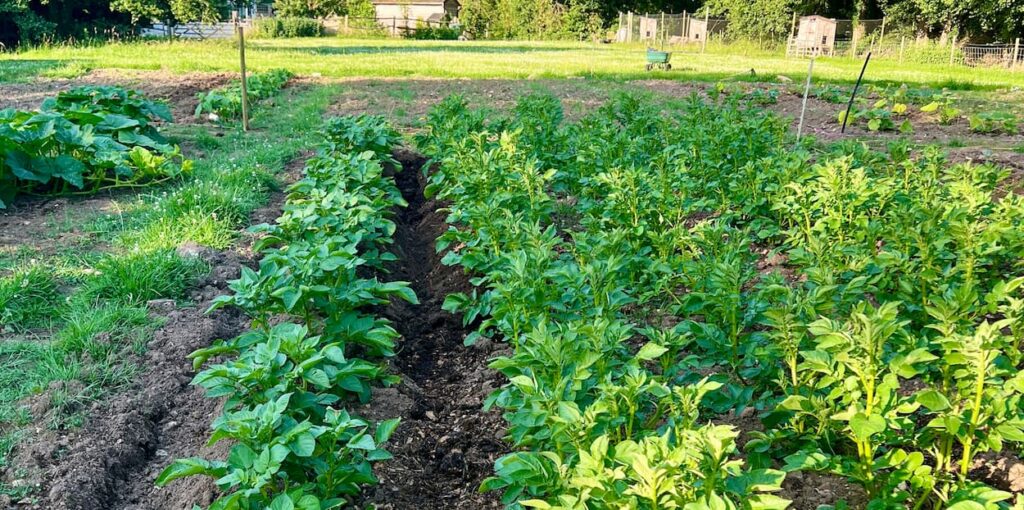
There are two main types of potato, the white potato that is widely eaten around the world, (that’s the one we use for making french fries) and the sweet potato which is a more sensitive plant that needs a little heat to work its magic.
In this article I’m going to be focusing on the white potato, a hardy vegetable that stores brilliantly and is an important source of carbohydrates for families worldwide. I’ll be looking at:
- Seed potatoes and when to plant them
- How I marked out my potato patch
- Spacing and planting potatoes
- Watering and earthing up
Seed potatoes and when to plant them
Seed potatoes are simply potatoes you plant in order to make lots more potatoes!
Once you’ve harvested your own potato crop you can save some of them to be next year’s seed potatoes, but if this is your first time, or if you want to try a new variety, you’ll need to order seed potatoes from a supplier.
Earlies vs maincrop
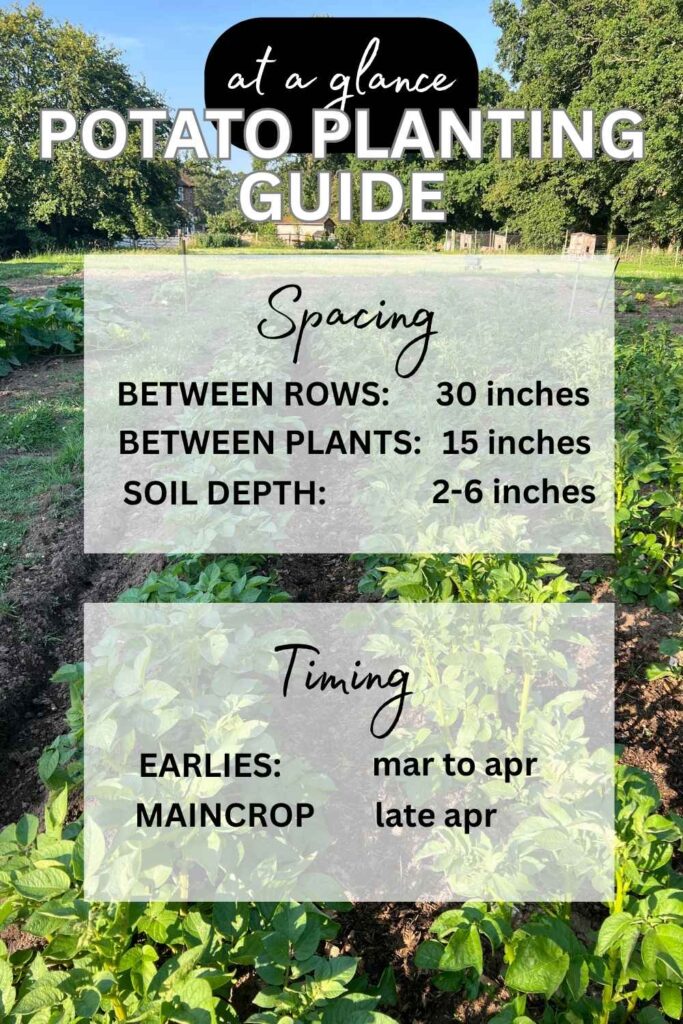
When it comes to timing, potatoes are divided into earlies and maincrop. I usually aim to get my earlies into the ground in March and my maincrop potatoes in by the end of April. But you can get away with planting maincrops in May.
The difference, between earlies vs maincrop potatoes, lies in how long they take to reach harvest size.
Earlies, or ‘new’ potatoes, are fast maturing varieties that are eaten while still quite small, and are not suitable for long term storage. They can usually be harvested just 3 months after planting. We do grow a few of these, but my new potato patch is focused on maincrop potatoes, as these are an important food source for my family over the winter.
Maincrop potatoes take about 5 months from planting to harvest and grow much bigger than earlies. Once lifted and if prepared properly, they can be stored for months in a cool, dry, dark place. I’ll look at preparation and storage in my harvesting article.
Is it too late to plant potatoes this year?
That depends where you live. If you have cold winters, what you need to remember is that potatoes need to be harvested by the first hard frost. And to maximise your maincrop potato harvest you need to count backwards 20 weeks from that date to arrive at your last planting date. I could have a hard frost in early October so to be on the safe side, I really should have had mine in by around 14th May. Whereas in fact, I didn’t get them in the ground until May 23rd.
So I’m taking a bit of a risk and may have to lift them before they reach their full size. Buying my potatoes late also meant they were well chitted when they arrived, and on the bright side, they were less than half price.
What’s chitting?
The ‘eyes’ in a potato are where the new shoots will sprout once the seed potato is planted. The appearance of these new shoots is called ‘chitting’ and potatoes grow more quickly if chitting has already started before they are planted.
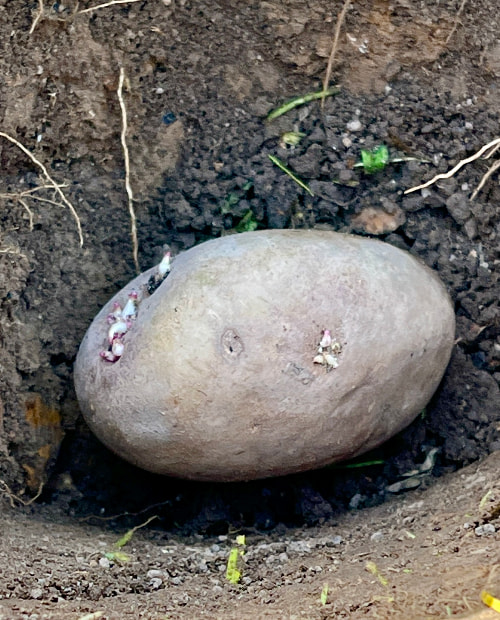
I get my early potatoes to chit by bringing them into the light – on a shelf near a window, or in a frost free greenhouse is fine. I don’t bother to do this with maincrop potatoes as there’s less urgency over getting them to sprout. (This year I’m only growing maincrop in the new patch as we were a bit late getting it underway, and because I left it so late, the seed potatoes I bought were already well chitted). I find it helps if you put the part of the potato with the best ‘eyes’ uppermost. And I’ll use and old egg carton to keep them in the right position.
Can you plant potatoes from the grocery store?
Maybe, maybe not. It depends if they are organic. Potatoes sold for consumption are sometimes sprayed with a chemical to inhibit sprouts developing from the eyes.
Organic ones might be ok. But seed potatoes are widely available online and in stores so you might as well use those.
Can you use your own potatoes from last year?
You can definitely do this and I have done this myself in the past. The downside is that you may not get such good results. Potatoes sold specifically as seed potatoes have often been tested to make sure they are disease free.
If you are growing your own and you are inexperienced you may miss signs of disease in the parent plant or in the potatoes which may result in a lower yield. It’s something to experiment with in small quantities to begin with
Marking out the rows in your potato patch
My new maincrop potato plot is 14 feet wide east to west, and about 35 feet long north to south. My potato rows run north to south and they are 2ft 6 inches apart. This will give them room to flourish. And me room to earth them up (see below)
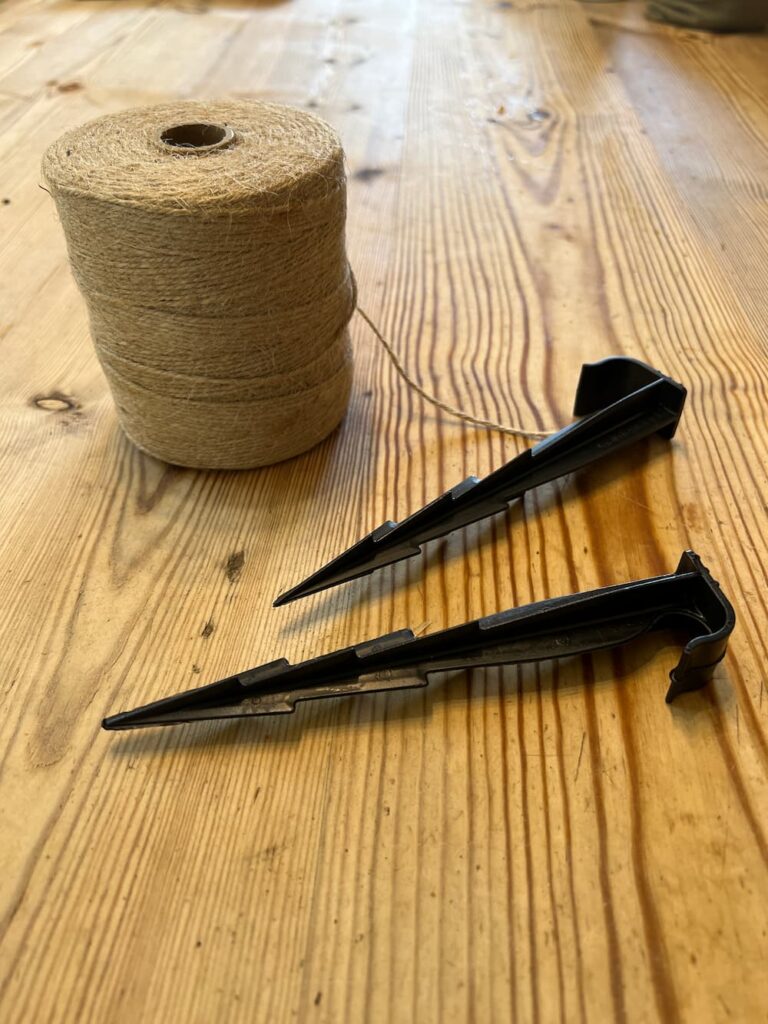
I marked each row with a length of string attached to a peg at each end. It isn’t essential to do this but it does help keep your plants in a straight line which makes it easier to earth up and hoe if necessary.
Please note: There are some product mentions in this article, these are things we use and recommend. Some of the links are amazon links and we earn a small commission from Amazon (at no extra cost to you) if you make a purchase after clicking on them.
This year, working with hard ground, I bought plastic garden hose anchor stakes from Amazon, and a rubber mallet to bang them in. But if you are good at whittling you could make your own out of sticks. They need to be about 6-9 inches long. I used natural jute twine for my string as it’s bio degradable and I like the look of it.
Spacing and planting guide
Everyone has their own idea about how far apart potatoes should be within each row. You’ll want to make the most of your plot, but if you plant them too close together they’ll be competing with each other for space and nutrients. I like to place mine about 18 inches apart
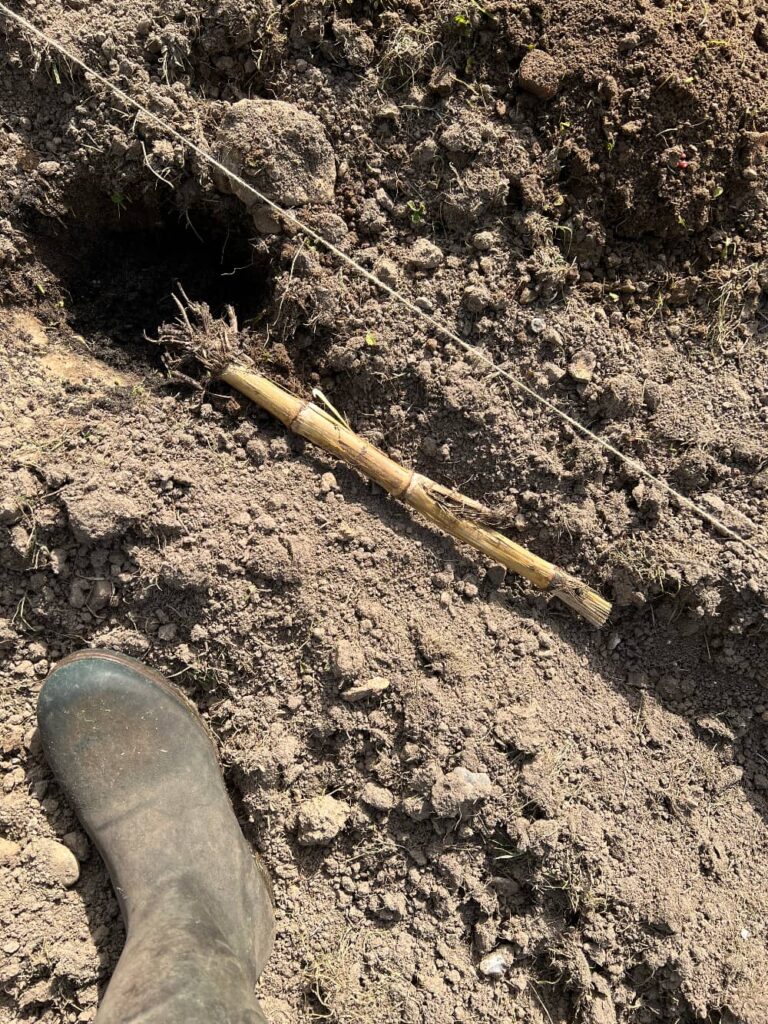
I don’t like messing around with tape measures while I’m planting so I trimmed a stick to around 18 inches long to help me space them out.
My potato planting method
I usually make a trench with the corner of the drag hoe down the length of my string for each row. The bottom of the trench is about 6 inches deep.
In this new patch, that was too difficult on the uneven and lumpy surface, so I dug an individual hole for each potato with a sharp trenching spade.
Many of these holes were nowhere near 6 inches deep. More of that in a moment.
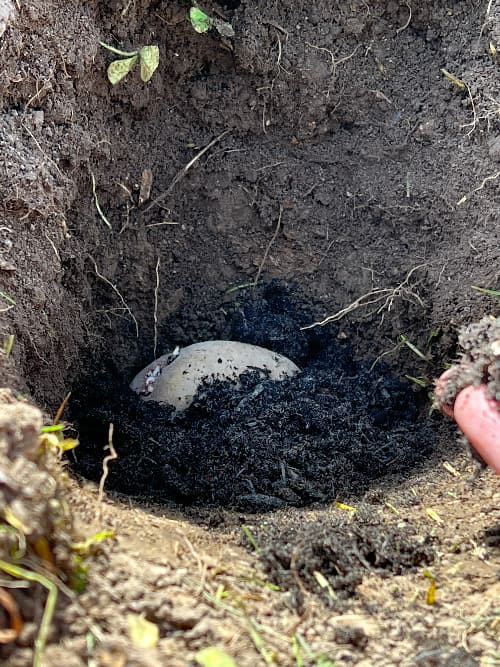
Because the soil is so stoney, I covered each potato with a couple of handfuls of potting soil purchased from the garden center. Followed by a trowel full of homemade compost. I left a bit of a depression where each potato was planted to hold water and I’ll be adding more DIY compost, and more soil once the shoots are through.
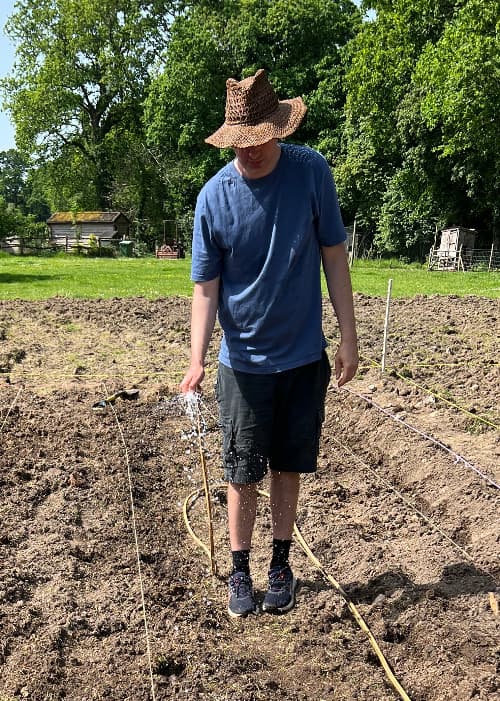
We finished up by watering each row thoroughly.
If you are planting earlier than me and you are worried about frosts, then you can also cover each row with a layer of straw or some horticultural fleece, to protect the vulnerable new shoots as they appear.
How long does it take to plant potatoes?
It took two of us two hours to plant four rows of potatoes in my new potato patch. And each row is 35 feet long. We planted about 11lbs of potatoes in those four rows. How long it takes you will depend on your soil.
We’re working on virgin ground that’s been coarsely ploughed and tilled once. So it’s still a very rough surface with lumps of turf, large stones, and quite a lot of debris in it. On a well established vegetable patch or somewhere that has had flowers planted on it recently, it will be a lot quicker. And more fun!
How soon do potato plants appear?
This year I planted my maincrop potatoes on 23rd May. A bit later than I’d have liked, but that’s when the new plot was ready for them. Normally I’d want them in by the end of April. But at least this way I don’t need to worry about protecting the new shoots from frost.
Usually, when I plant in April, I protect the new shoots with straw until the risk of frost is over. Potatoes don’t mind being covered and will push their way through the straw to find the light.
This year, in hard stony ground, and all risk of frost past, I decided to take a chance with shallow planting. So my new shoots only have to push through the handful of potting soil I covered them with, plus the layer of homemade compost (about an inch) above that.
On the day that the potatoes went into the ground an unprecedented heatwave began. It was the hottest May on record in the UK, during which temperatures reached into the high 80s, and after a few days of this it suddenly occurred to me that my seed potatoes might actually have cooked so near the surface! So I rushed outside with a trowel and scraped some soil away to see if there was any sign of life!
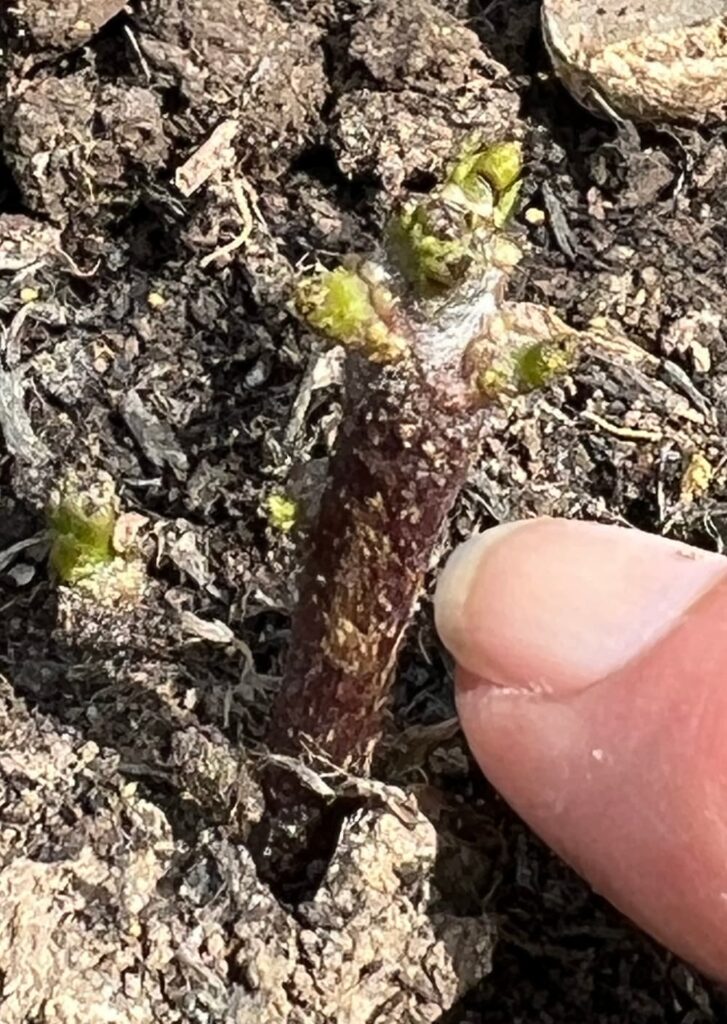
My worries were unfounded. And when I looked around more closely I could see several more shoots breaking through to the surface on their own, just five days after I planted them. So exciting! And soon it would be time to start earthing up. Let’s find out what that’s about.
Earthing up and watering
Earthing up means piling soil up against the stems of the newly emerged potato plants as they grow. If you plant your potatoes in a deep trench, then all you need to do is fill the trench in gradually as the potatoes grow taller.
With my stoney soil, my potatoes weren’t planted very deep at all. So earthing up is a task I need to include in my potato care system. I’ll explain how I do that in a moment.
I’ll also talk about my watering system because potatoes are quite thirsty plants and I want to be sure that mine get enough to drink.
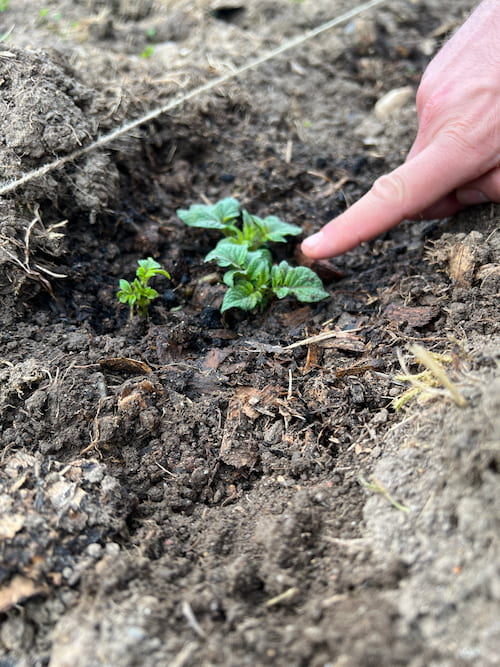
What’s the point in earthing up?
Like most plants potatoes produce chlorophyll on parts exposed to the sunlight. Chlorophyl is the chemical that gives plants their green color. That includes the tubers.
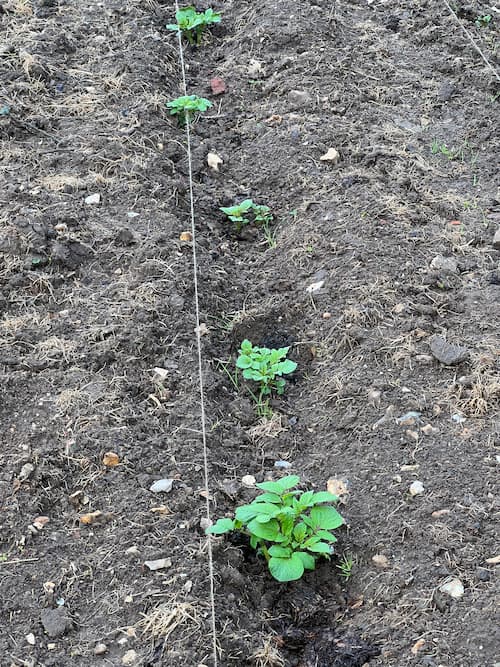
If you let your potatoes develop near the surface of the soil, and they get exposed to the sun they’ll turn green.
I don’t want that happening to my potatoes so I earth them up as they grow. The piled up soil blocks out sunlight and makes sure that none of my potatoes are spoiled
When to earth up potatoes
I like my potato shoots to be at least 4 inches tall before I start to pile earth around them. In reality, this year, I left it a bit later than this.
It’s still worth doing no matter how late you leave it. And you’ll usually need to do it more than once.
Earthing up method and tools
Earthing up involves dragging a sharp tool down the central point between two rows of potatoes, scraping a trench out, and pulling the soil up and around your potato stems.
It’s a bit of a workout, and I like to do it in the early part of the day or later in the evening, before it gets too warm.
This is where a decent tool really does pay dividends. I use a Warren hoe for earthing up my potatoes. Mine is a triangular hoe, but a specific type of triangle.
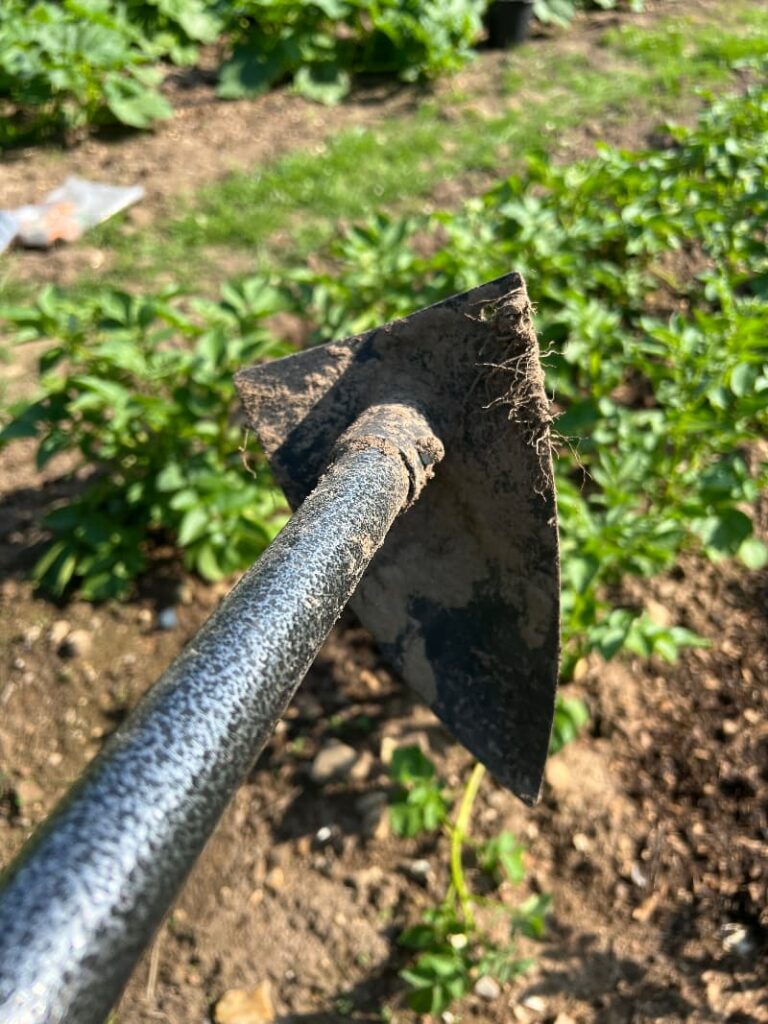
Most triangular hoes have three equal shaped sides. But for earthing up, I prefer this longer narrower blade. I use the pointed end to break up the soil in the bottom of the trench then turn it onto its side to drag the soil up into a mound.
Please note: There are some product mentions in this article, these are things we use and recommend. Some of the links are amazon links and we earn a small commission from Amazon (at no extra cost to you) if you make a purchase after clicking on them.
I might change the handle for a solid wooden pole at some point as the sections do need tightening back up from time to time. I bought my warren hoe on Amazon but you can get them in many garden centers.
Don’t worry if you accidentally bury a few potato leaves, you can lift them out with your fingers as you go, but if you don’t, the plants won’t mind.
How often to water your potato patch
This depends somewhat on your soil and on the weather. I have a three day rule. If it hasn’t rained for three days, I water my potatoes early in the morning. And by rain I mean a decent heavy shower, not a few sprinkles.
I could water every other day, but I find it easier to have a routine of things I do each day, than to remember whether or not today is watering day. So if the rain stops, I count 3 days and then daily watering kicks in. And we always keep a note of the last day it rained on our kitchen whiteboard.
What about feeding?
If you are growing maincrop potatoes I find I get a bigger crop if I dump plenty of organic material around them. So when I have earthed them up, I’ll often tips some homemade compost in the trench between the rows.
No need to rake it in, the worms will take care of the for you.
The waiting game!
Once my maincrop potatoes are in, and I have set up a watering routine, I make a note in my smartphone reminders to check them once a week or so.
Right now I’ve just completed my third earthing up. We’ve had two heatwaves and I’ve had to water the potatoes a lot more than usual. So I’m hoping for some rain in the next day or two
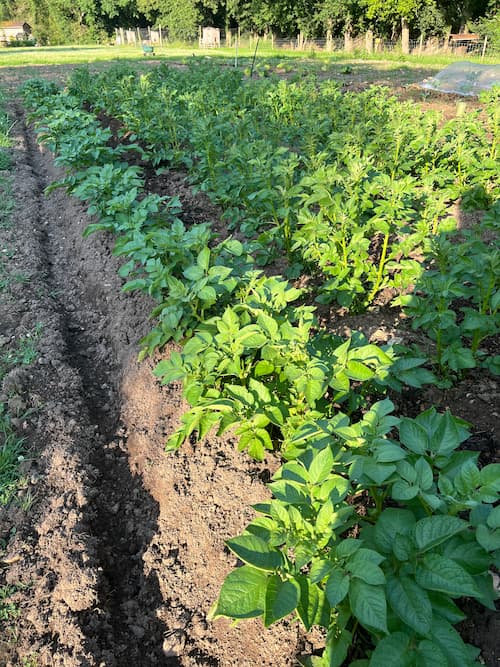
I hope you enjoy getting started with potatoes – they really are so rewarding and they grow so fast!
My own potato plants are growing super fast in the hot weather we are having this year. I’ll earth up another time or two, at least until there is no room to walk between the rows. But my main job now is to water and wait for the foliage to begin to die back. That’s my clue that it’s almost time to harvest!
I’ll be updating with a harvesting and processing report later in the year, so check back soon.