How To Make A Herb Container Garden – With Step By Step Planting Guide
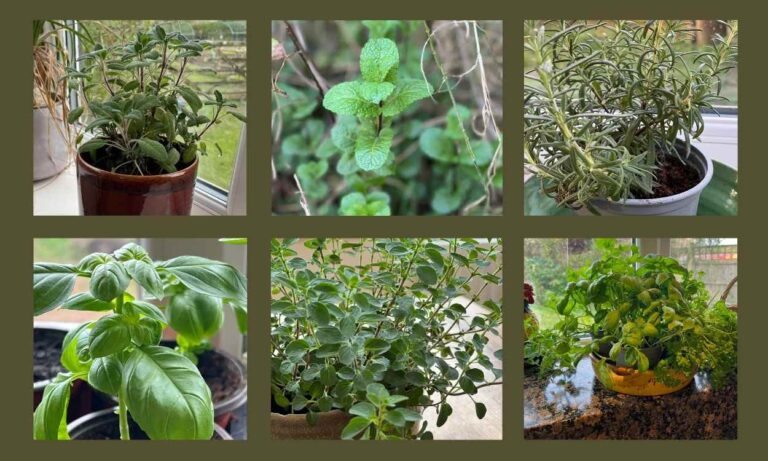
Today I decided to move some of the herbs that have been growing on my kitchen windowsill over the winter, into a container outdoors. I love the convenience of herbs on my windowsill, but let’s be honest, most herbs would be happier outdoors if given the choice.
I’ve recorded how I did this for you, and I’ve included plenty of tips to help you make your own herb container garden
Why grow herbs in containers?
You don’t need to plant herbs in pots or planters, you can just put them straight into the ground, and indeed, some of my herbs are planted straight into beds in my vegetable garden.
But there are definite benefits to growing some of your herbs in containers. And for me these include:
- The ease of controlling soil quality and especially drainage
- The portable nature of containers
- The ability to control aggressively spreading herbs
Pots control the fun!
Last winter I lost a lovely sage plant due to the soggy soil in our vegetable garden after weeks of wet weather. And this loss was my primary motivation to put some sage plants into a container this year.
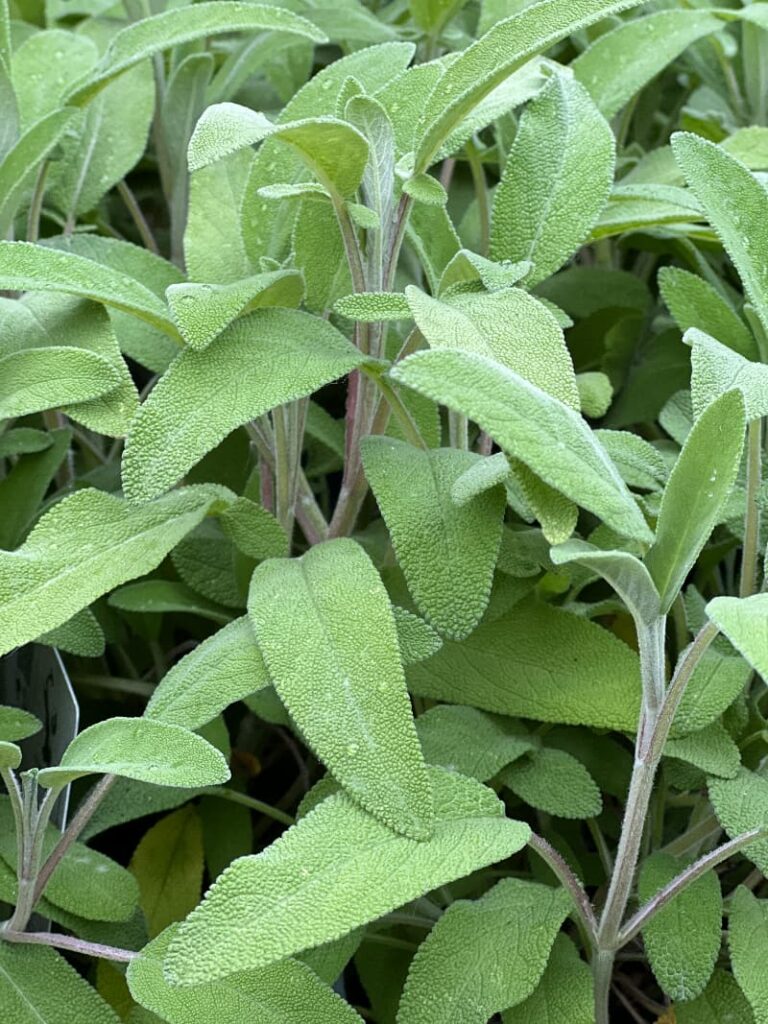
Keeping herbs in a planter or pots makes it much easier to ensure the soil your herbs are sitting in, is well drained. So if like me your garden is prone to waterlogging in the winter, containers are a must.
Moving pots around
I love that pots can be moved. I’m very prone to changing my mind and its a lot easier to move a herb in a pot than it is to dig it up and plant it somewhere else!
It also means that I can keep my outdoor herbs near to the back door, even though that part of my yard is paved.
Invasive herbs
Some herbs are very prone to rampaging across your yard and overwhelming more sensitive plants. Mint is a prime example. Lemon balm is another. Our yard is pretty spacious and I have some wild areas where my mint plants can’t do much harm. But if you have a nice ordered space or not very much space, then a planter for your mint or lemon balm is a really good idea
There are a couple of other situations where planters have a real advantage. Planters can be set up on a balcony or in a window box, so that you don’t even need a garden or yard to make a herb container garden
And containers can provide access to gardening for those with limited mobility. You can set up a container that’s raised so that anyone in a wheelchair or that has difficulty bending over, can enjoy gardening too.
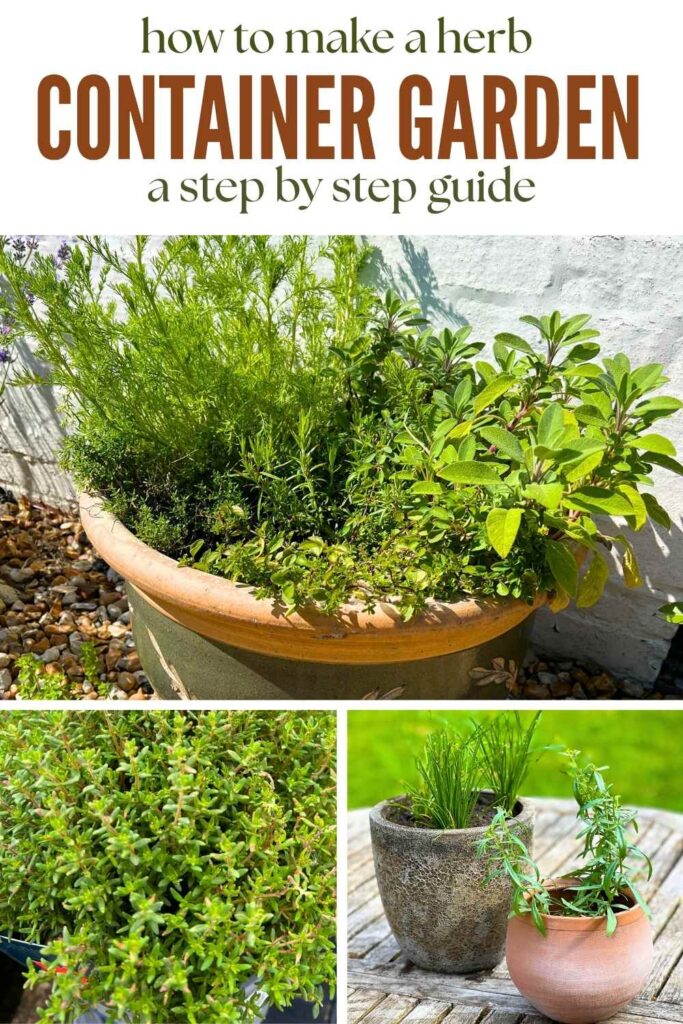
Choosing the right container
Because herbs don’t tend to cover the pot entirely in the way that some summer patio plants do, I pick my herb containers based on what they look like. And of course this is a matter of personal preference. But there are a few things you do need to take into consideration, including:
- Porosity
- Drainage
- Size
How porous is your pot
From a purely aesthetic point of view, my favorite material for containers is probably terracotta, in good old fashion plant pot color. I also like some of the weathered stone pots and some rustic ceramic pots.
Half wooden barrels and wooden troughs can look lovely too. But some of these materials, especially terracotta and wood, are very porous. That means they dry out fast in strong sunshine.
As most herbs love sunshine, this can be a problem. So in my garden I tend to put herbs in glazed ceramic pots
Bear in mind that many porous pots are not frost proof. The water in the walls of the pot freezes as it expands, and your pot cracks and crumbles. So if you are making an all year round planter like mine, you need to take that into account.
Check for a drainage hole
Indoor pot holders are generally watertight and may be on sale among outdoor containers. This won’t work outdoors as herbs will rot if their roots get too wet.
The last lot of plastic pots I ordered for some patio begonias, were advertised as having drainaged holes, but though these were marked on the pots, they needed drilling out. So do double check before you plant, that your chosen pot has a good sized drainage hole, and be sure not to block this off.
Size may matter
The bigger a pot, the smaller the surface area of that pot relative to the volume of contents inside it. So if your pot is porous AND small, it will lose moisture much faster than a very big porous pot.
And even if the pot is not porous, there will be relatively more moisture loss from the surface of the soil. The contents of a small pot will heat up and cool down faster. Compared with a larger pot where the temperature will be more stable.
Generally speaking bigger pots need less frequent attention than smaller ones. Though of course you need to balance that against cost.
Window boxes and hanging baskets
Containers aimed at summer flower displays such as window boxes and hanging baskets can work for herbs, but remember these are often highly porous, especially baskets, and can dry out very quickly so you’ll need to water more frequently.
Oregano and thyme will trail over the sides of baskets and boxes and enjoy the excellent drainage they provide. Oregano tends to grow faster and will give you better coverage if time is short.
Choosing your herbs
I decided that this container will be a permanent one, and my priority was my sage plants, so I needed to pick mainly frost hardy herbs to keep my sage plants company. I also needed to make sure that there was no bare soil for my cat to dig in, so I would need to fill all the available space.
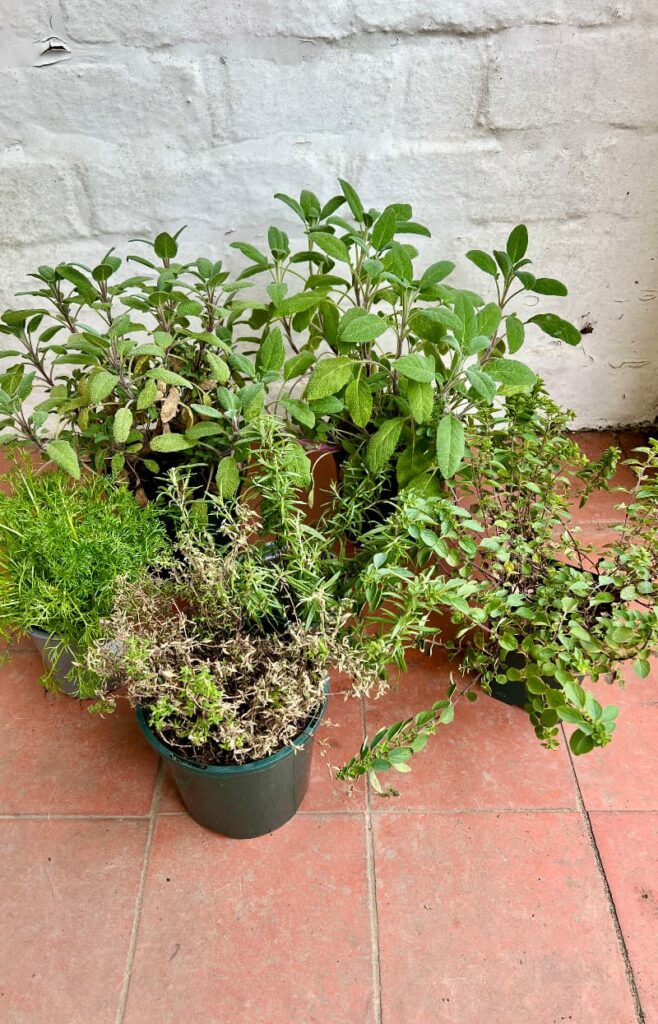
When you choose herbs for your planter, they need to have these things in common
- They are similarly hardy (or tender)
- They like similar soil
- They like similar moisture
- They have similar light requirements
If you are planting a wide variety of herbs you’ll need at least two containers. One for herbs that like dry conditions, and one for herbs that like more moisture. You can read more about this topic in my article on Herb Companion Planting
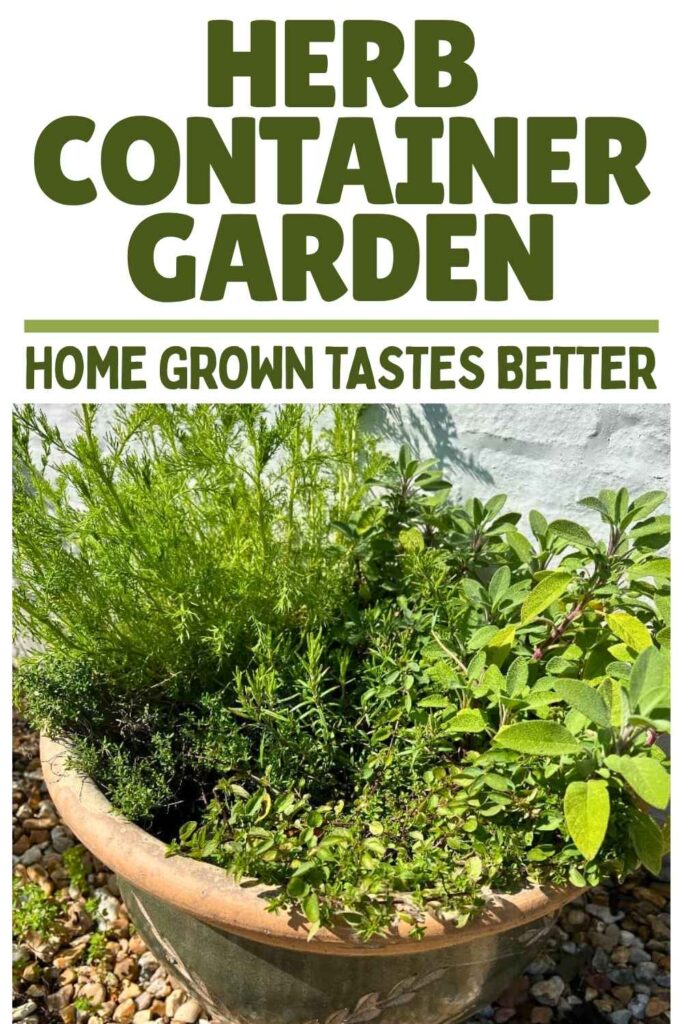
Sage is a perennial herb that can live for several years, so I wanted most of its companions to be perennials too. Rosemary, oregano and thyme are good candidates and I included these in my shortlist. They are also all drought tolerant mediterranean herbs that like plenty of sunshine and well drained soil and will tolerate poor soil and irregular watering
I popped some chamomile in to fill up the remaining space. Chamomile is an annual but by the end of the year when it dies, the other plants should have grown enough to cover the soil.
Your choice will depend on the herbs you like to cook with. And of course you don’t have to make a mixed planter. Various pots of different shapes and sizes with different herbs in each can look lovely and if placed near to one another give the illusion of a mixed herb garden
If you have a pot that isn’t frost proof, fill it with annual herbs, or herbs like basil that don’t survive the winter outdoors in your region. Then at the end of the summer, you can empty the pot out and store it for next year, or bring it indoors for a few extra weeks of flavor.
Planting Your Herbs – Step By Step
1 Preparing your potting soil
Standard store bought potting soil is good at retaining moisture, but for my dry sun loving mediterranean herbs I wanted an extra well drained growing medium. So I mixed some horticultural sand (about four parts compost, one part sand) and several handfuls of perlite, into the container. This just helps to improve the drainage
It’s best to use horticultural sand rather than builders sand which may have salt or other products in that plants don’t like. If you are planting more moisture loving herbs like mint, parsley and basil, then your store bought potting compost will be fine.
2 Arranging your herbs
I like to fill the container to about 3 inches below the top before I start planting, and position my plants, still in their pots, where I think I will want them. This helps you get the look of your arrangement right.
Place taller, more vigorous herbs to the back of the container, and herbs that will trail over the edge near the front so you can see them
I’ve put rosemary in the middle of my container as a feature because rosemary grows quite tall and I can trim out the lower branches if the other herbs need the space beneath it. The sage plants I located either side and to the back
3 Preparing your herbs for planting
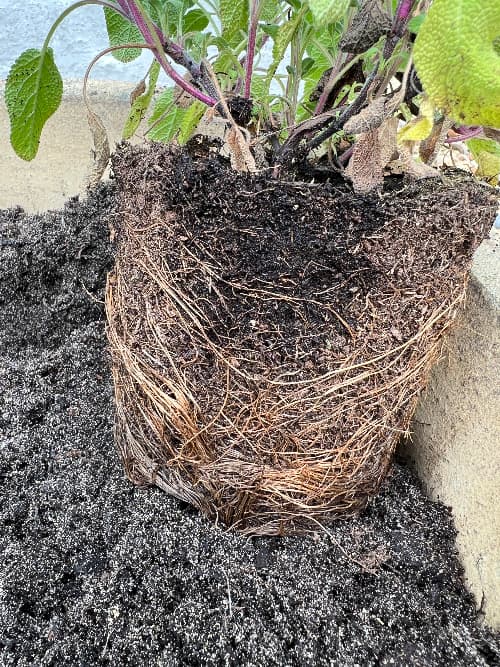
Take your first plant from the back of the arrangement, and place two fingers across the top of the pot either side of the stem. Then invert the pot and tap it gently on the bottom until you feel it come loose. Lift the pot away with the other hand and put it to one side
Now with your fingers, gently tease the roots to loosen them a little. This helps them get started.
4 Planting – how deep should you go?
Some plants hate having soil up against their stems, so its usually a good idea not to plant the herb too deep. Just deep enough to cover the existing root ball.
Scrape a hole a little less than the depth of the root ball and place the plant into it. Push a little potting soil around the plant and with your knuckles, firm it down gently and push a little more soil around it.
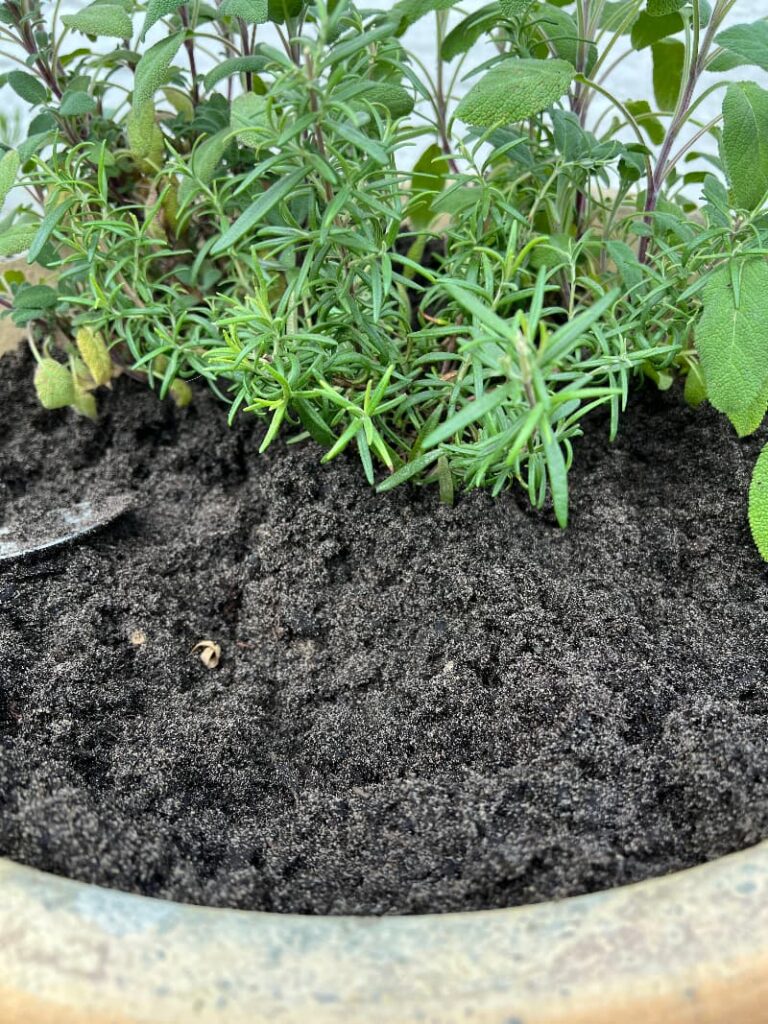
Repeat with the plants at the back and work your way to the front of the container, scraping a hole, and inserting and firming in, each plant in turn. Planting will have raised the soil level a bit, but If necessary, top it up so that the final level is about an inch below the top of the container
5 Watering in
Now you need to water the plants thoroughly to help them settle in to their new home. This is true even of herbs that like dry conditions. This first watering is important.
Take care not to wash soil away from the root balls. If you use a full size watering can make sure there is a rose on the end of the spout. Or pour gently with a houseplant watering can with a small spout.
Caring For Your Container Herb Garden Day To Day
Mediterrenean herbs in a large planter will not demand much of your attention. Trim regularly during the growing season to keep those fresh young shoots coming and water when the soil is dry about an inch below the surface You can by a humidity probe, but its a simple matter to stick your finger in the soil to test.
In very warm dry weather you may need to water your herbs each day, possibly twice a day when its very hot if you have planted the more moisture loving herbs such as basil and parsley.
I usually find rosemary, sage, oregano, and thyme are fine with once daily watering in hot weather. And every other day in warm, dry weather.
Be careful of assuming you won’t need to water in wet weather if your container is up against a wall. The wall can create a rain shadow which greatly reduces the volume of water available to the plant.
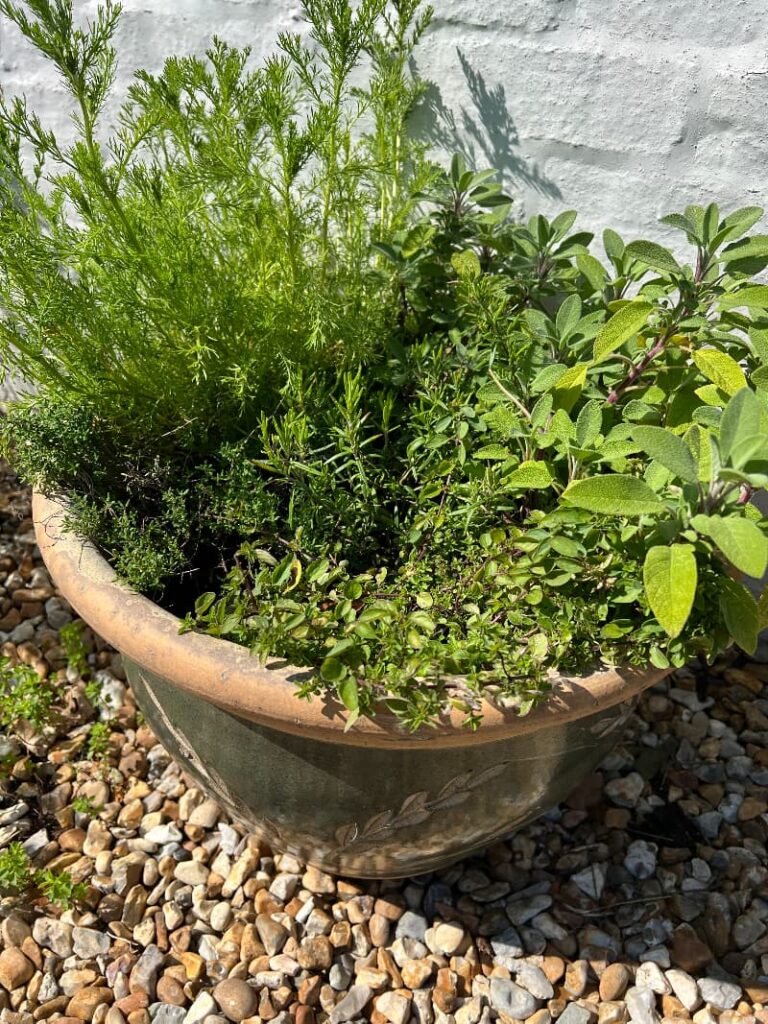
My herb container garden after six weeks
I put my herbs in my planter in early May and after six weeks they had settled in nicely
The thyme has recovered as I’d hoped. Though the chamomile is rather swamping that side of the container. So I may replace that with some tarragon that I have on my windowsill.
Good luck with your herb planter, and do let me know which herbs you chose in the comments below!