The Complete Guide To Pothos Varieties; Find Your Perfect Plant
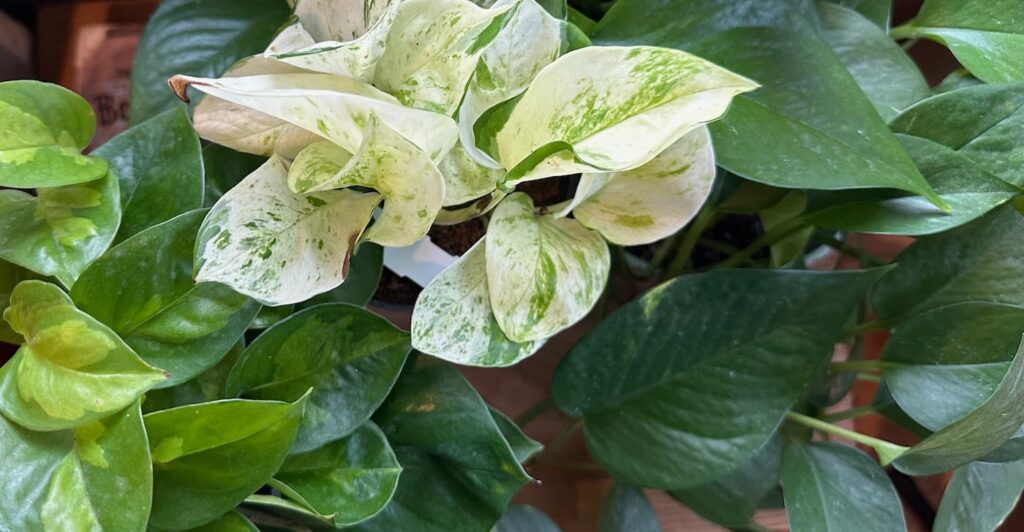
I might have too many pothos plants. Or I might not have enough. It’s hard to say. On the one hand, I’m running out of windowsills. On the other hand, there are at least ten popular varieties of pothos, and dozens more that are less well known or harder to find. My collection is far from complete. The solution is probably to buy a bigger house. Let’s take a look at all the pothos options out there, so you can see if you need a new plant or three, too!
The Pothos Family
Pothos plants can be divided into a few distinct groups.
- The classic golden pothos and it’s older cultivars
- New, patented or registered golden pothos cultivars
- The ‘pinnatum’ pothos group
- And the satin pothos, which is a bit of an imposter
Golden Pothos; The Gold Standard
I’ve said it before, and I’ll say it again. My golden pothos is my favorite houseplant. It has green leaves with pretty light yellow and cream streaks. It grows vigorously, trails beautifully without going stringy, propagates easily, hardly catches any bugs, and is just generally easy going.
This plant likes pretty much any temperature that I’m happy to live in, doesn’t mind if I forget to water it, and just seems to always look healthy. If you can’t tell, I’m a fan!
When someone tells me they’d like to start growing pothos, I’m always tempted to just advise them to get a nice, easy, golden pothos. But in case you’re looking for something a little more adventurous, let’s take a look at the other options!
“Old School” Varieties of Golden Pothos
The proper name for golden pothos is Epipremnum aureum. It evolved naturally in tropical regions, but has been grown commercially since the late 1800s. In the wild, golden pothos can vary a lot in their coloration and appearance. And over time, gardeners have intentionally directed and combined some of those traits to create unique varieties of golden pothos called cultivars.
Some of those cultivars have been grown and sold in western plant nurseries for so long that no one is really sure where they originally came from. For decades, just four varieties of golden pothos could be bought as houseplants in the USA. The original golden pothos, and the sub-species ‘Marble Queen’, ‘Jade’, and ‘Neon’.
Marble Queen: the original cultivar
Epipremnum aureum “Marble Queen” is a variegated form of golden pothos, with beautiful green and white marbled leaves. It seems to be the oldest known cultivar of golden pothos, perhaps dating back to the 1970s.
Marble Queen has a lot of paler cream speckling across its leaves. The pale areas of leaf are low on chlorophyll, the molecule that helps plants turn sunlight into energy. So the green areas need to work harder and faster to make enough energy for Marble Queen to grow and be healthy. To support this, your plant will need lots of nice bright light.
But the pale areas are also more easily damaged by light, so it’s extra important not to give Marble Queen too much light, and to keep light indirect. Too much light scorches the leaves. Too little light makes your plant slow to grow, and can also cause the leaves to lose their variegation, and become predominantly green.
Near a window, but not ‘in’ the window, is a delicate balance that Marble Queen lovers have to continually play with to keep right as the seasons change.
Neon and Jade: The ‘boring’ non-variegated ones
It’s easy to forget that the random golden streaks on a standard golden pothos plant are actually a form of variegation. The ‘special’ thing about the remaining two older cultivars of golden pothos, is that they are not variegated. And that’s actually very unusual for a pothos.
‘Jade’ pothos has a uniformly dark green leaf. And ‘Neon’ has a paler, brighter, almost yellow green leaf. Both have been described since at least the early 2000s, before all the modern patented varieties arrived on the scene
Easy-going ‘Jade’
Jade is very similar to golden pothos in temperament. It grows lush dark green foliage that tolerates lower light reasonably well, although it will grow more slowly if it doesn’t get some bright light. The big heart shaped leaves look a lot like heartleaf philodendron at a glance, but Jade has a grooved leaf stem (petiole) – a classic pothos feature. And in my experience Jade grows a bit more vigorously than its philodendron cousin, too.
Vibrant ‘Neon’
Neon pothos is much louder and brighter than Jade, with solid yellow-green or lime green leaves. Neon likes as much bright indirect light as you can give it. Those yellower leaves are lower on the yummy chlorophyll that makes energy for the plant. Dim light will lead to your plant trying to ‘save’ itself by making more chlorophyll, which dulls the bright leaves. This is a pothos for people who like a pop of color and have lots of well lit space, away from the direct light of south or east facing windows, to offer their plants.
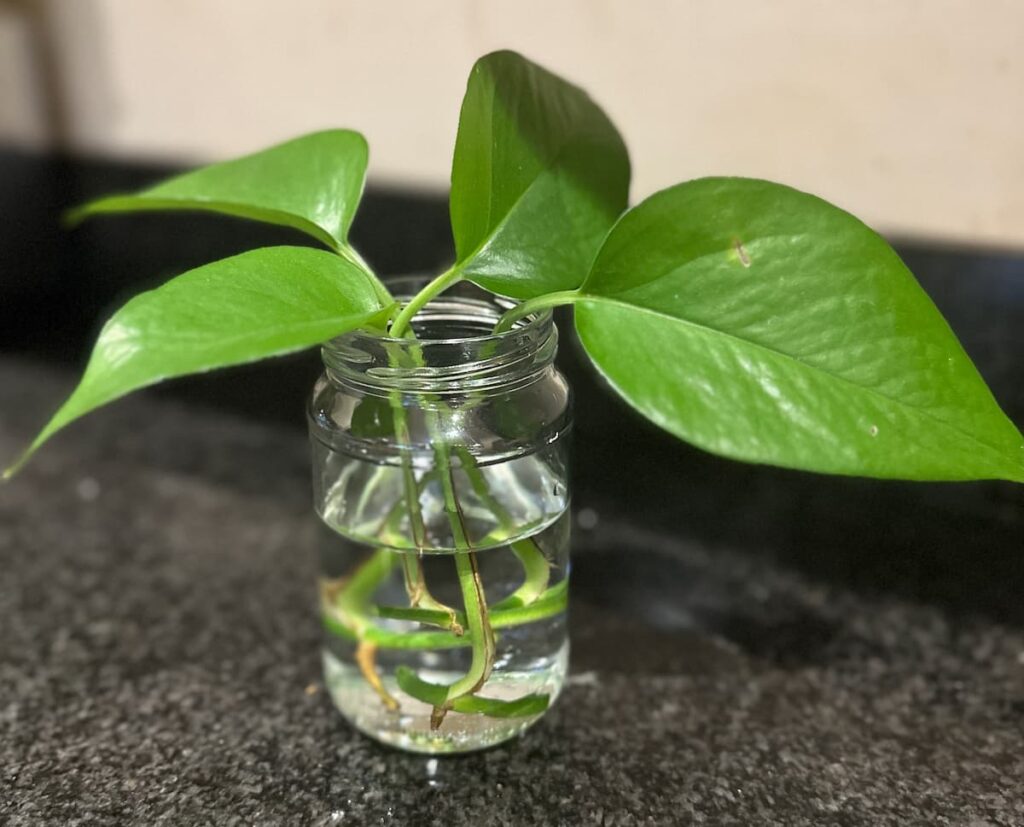
Traditionally, new pothos cultivars like Neon and Jade were grown by taking cuttings from stems that had a natural variation in color or pattern. I’ve taken some cuttings from a golden pothos stem that just happened to have no variegation, recently, and I’m very interested to see if I end up with new plants that look more like a Jade than a traditional golden. I’ll keep you updated!
Modern Cultivars of Golden Pothos
The world of pothos houseplants changed dramatically in 2009, when the first patented cultivars were registered. Instead of being developed from stems with natural variations, two of these cultivars were created by forcing mutation in plants, using gamma radiation. This was helpful because pothos doesn’t naturally flower when kept as a houseplant, so it wasn’t possible to cross breed plants to get natural variation. Which is why there were so few pothos varieties in the 20th century.
Since 2009, more mutations have been derived through other scientific methods, including tissue culturing and using plant hormones to force plants to flower. And some more natural variations have come along too. Just like our old school varieties above, these are all technically sub-species of golden pothos, but tend to be known by the name of their cultivar. For example: Epipremnum aureum “Global Green” is usually just known as Global Green.
Let’s take a look at some of the most popular modern cultivars, starting with my personal favorite.
Global Green Pothos
There’s something just so pretty about green on green variegation. My Global Green pothos is a relatively new addition to my collection, but it’s already a firm favorite. The leaves are wider and rounder than on a golden pothos, shiny and dark green, with a ‘paint splash’ of brighter, lime green, in the middle of the leaves.
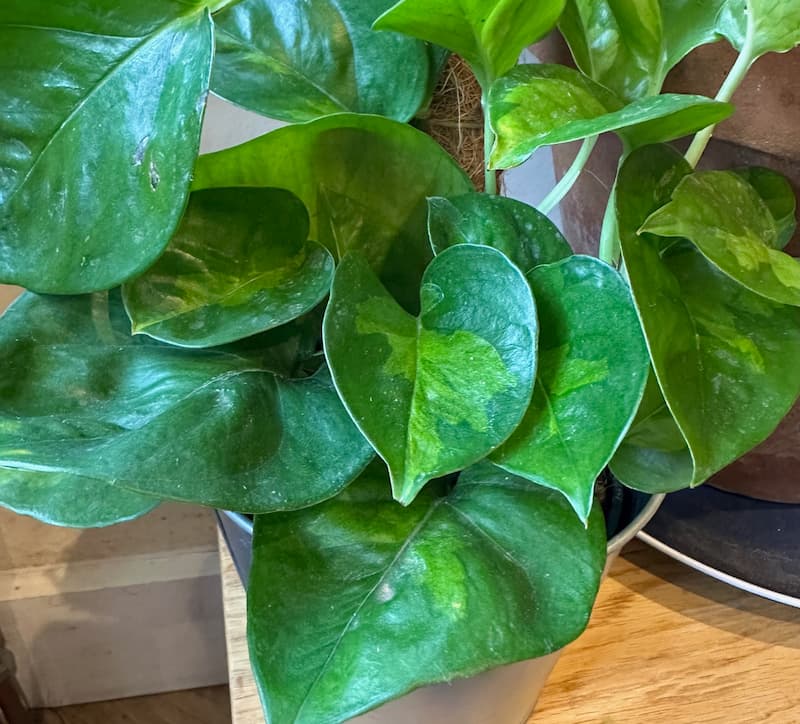
Global Green was developed in Japan from a naturally occurring mutation that was then propagated from cuttings. Mine has one long stem with large unvariegated leaves, which I’ve supported with a moss pole, and a cluster of smaller variated leaves below. I’m hoping the unvariegated stem is the original older leaves of this fairly young plant, and that future leaves will have more variegation, but I love it either way. It looks healthy and happy from a distance, and the bright green splashes are like a little treasure or surprise that visitors discover when they look closer. It brings people joy. What more could you want from a plant?
In terms of care, Global Green again likes bright indirect light. My front window faces north-west, with slatted blinds, and my Global Green seems happy set about a foot (30cm) back from this.
N’Joy Pothos
Next up, a pothos with much more dramatic variegation. N’Joy pothos plants are a natural mutation of Marble Queen. But unlike the streaked and speckled Marble Queen, N’joy has large white and green patches, on small, closely spaced, leaves. They form a compact little plant that makes a bright splash of interest in a corner or on a shelf. And, yes you guessed it, that spot needs to have plenty of bright, indirect, light!
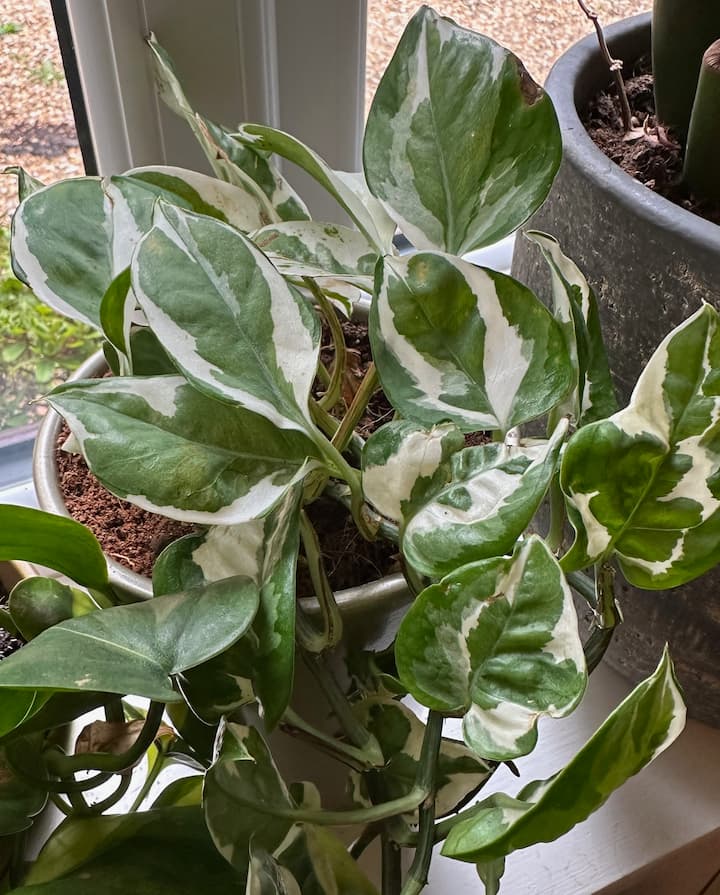
In theory the white sections of N’joy’s leaves are more easily scorched than ordinary pothos plants. And I have certainly observed this with other variegated plants like my philodendron white princess, and the Happy Leaf pothos we’ll look at below. But my fellow Pumpkins writer, Lucy, has her N’joy pothos in a south facing window, albeit one that’s quite shaded by trees, and it seems to like it there. So perhaps N’joy’s isn’t as fussy as we’ve been told!
‘Pearls and Jade’; the science pothos
‘Pearls and Jade’ is the most popular of the original ‘science’ pothos cultivars. Scientists at the University of Florida irradiated Marble Queen cuttings with gamma rays, to try to stimulate a new mutation. And ‘Pearls and Jade’ was the result.
It has a green center leaf with cream borders specked finely with more green. Like N’joy it’s a smaller, compact, plant, with smaller spacing between leaves than a standard golden pothos. The leaves are small too, so it can be a good fit (literally) for narrower shelves and smaller spaces.
Manjula pothos: aka Happy Leaf
Last but not least, the very sweet looking, wavy leaved, Manjula or ‘Happy Leaf’ pothos. Buyer be warned; I find this one is only actually ‘happy’ in very specific light levels. The shaded light coming through the slats of the blinds at my front window, which my golden pothos loves, scorched the leaves on my Happy Leaf.
Manjula pothos have highly variegated leaves, with a lot of cream. Mine is more white than green. This makes getting it enough light, without overdoing it and upsetting it, a delicate balance. We’re currently trying the kitchen window, which faces north-east but is overlooked by a building just a few metres away. The light there is quite diffuse, and most of my plants sulk and refuse to grow when placed there. ‘Happy’ seems very pleased with this spot, has stopped scorching, and is even growing a little taller. Not bad for a low light level window at the end of October!
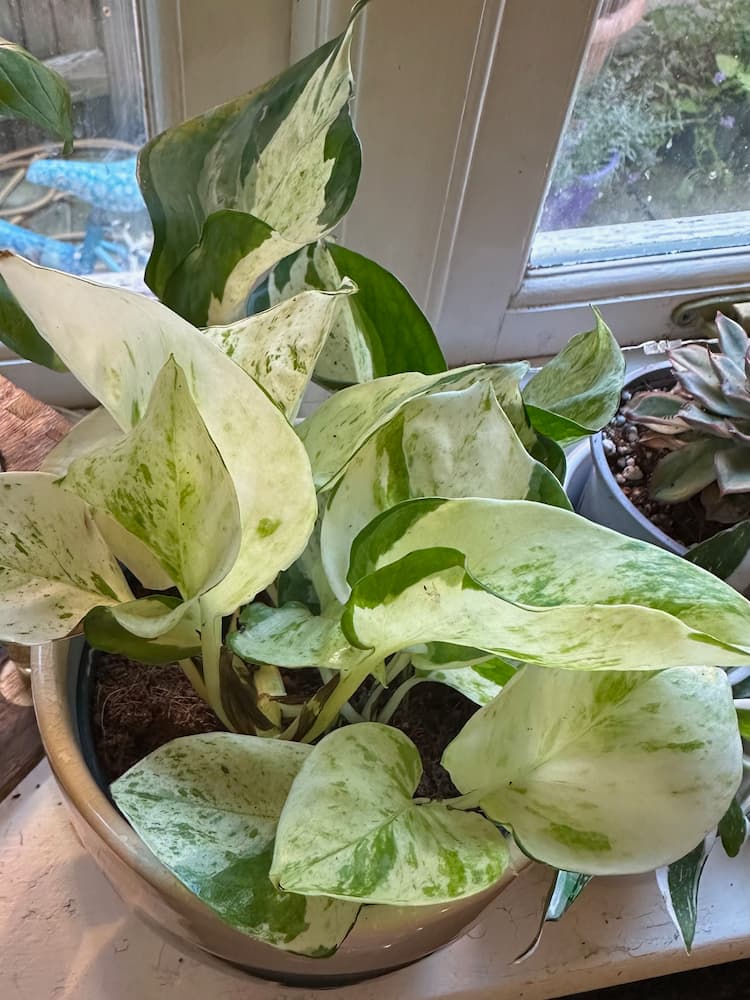
In fairness to Manjula pothos, they probably are worth a little extra effort. The wavy leaves are very characterful, and the variegation is beautiful, with very different distribution from leaf to leaf. But light levels are definitely something to be aware of with this one.
The leaf patterns vary a lot from plant to plant, too. So if you have a certain look in mind, it may be a good idea to buy your Happy Leaf in person, at a nursery, rather than ordering it online.
Honorable mentions
We’ve only touched on the wealth of varieties of golden pothos that are available nowadays. There are more arriving all the time now, and they are all beautiful in their own way. Incase you’re looking for something a bit more unusual, I just want to give a quick shout out here to Jessenia, which has lime on green marbling, and Lemon Meringue, which has leaves with dark green centers and bright, lemon yellow, edges.
Of course, if you’re looking for something a bit different, there is an entirely different pothos species, that deserves a mention too…
Feeling Blue? Meet The Pothos Cousins!
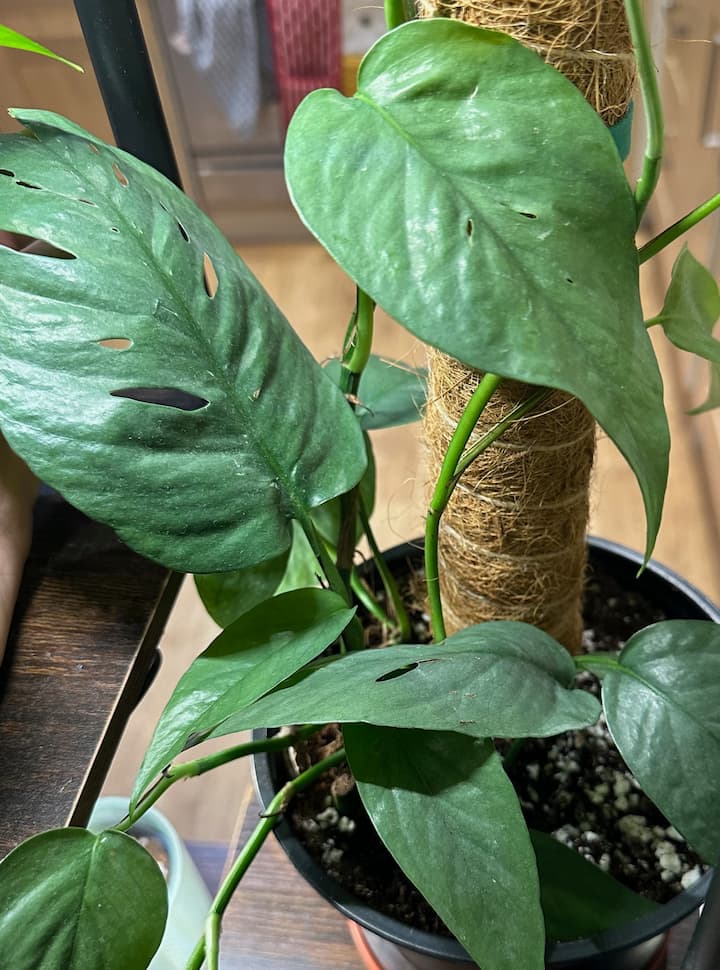
One of the newest arrivals in my home is a Cebu Blue pothos. I love it. The leaves are blue-green and more pointed than a golden pothos, with a subtle satin-looking sheen. And large mature leaves fenestrate. Some leaves on my new, quite small, plant are already fenestrating, which made it very exciting to unwrap when it arrived in the post!
Cebu Blue is a cultivar of Epipremnum pinnatum; a separate species from golden pothos, but a close cousin. In general it needs the same sort of care as a standard pothos, and the price was also very similar. But there are a few little differences.
Looking after E. Pinnatum
Pinnatum really do like to climb. Especially if you want fenestrations. I gave mine a moss pole about 5 days after it arrived with me, once I was happy that it had adjusted to its new environment and was likely to tolerate a bit of tugging about. They can also be a bit fussy about warmth and humidity. Mine is well away from any windows where drafts could upset it (its october as I write this), and is therefore under growlights to make sure it gets enough light. My plan was to move it to the bathroom if it didn’t thrive under lights – but so far it seems happy. In fact, it’s already grown so much I will need to make some more space for it soon!
If you’re considering buying a Cebu Blue, or its sister cultivar the Baltic Blue, be prepared for them to want a little bit more TLC and to grow a bit more slowly than a standard golden pothos. But so far I’ve found mine a lot less work than a heavily variegated golden pothos cultivars. So it’s a good compromise if you want something fairly simple to care for but with a bit of dramatic flair!
Variegated Epipremnum pinnatum
There are some variegated cultivars of E. pinnatum, which deserve a mention of their own. The most well known is probably ‘Marble’ pothos (not to be confused with ‘Marble Queen’ which is an aureum cultivar). ‘Marble’ has white marbling on a very pointed, fenestrating, green leaf.
A couple of very pretty, less common, varieties are ‘Albo’ and ‘Sunburst’. Albo has a patchier variegation that reminds me of ‘Thai constellation’ monstera – especially once the leaves fenestrate. And E. pinnatum ‘Sunburst’ has striking yellow streaks, that make it look like a slim leaved, fenestrating, extra colorful, golden pothos. I’m a fan!
Just like our variegated golden pothos above, variegated pinnatum pothos can be slow growers that are picky about light levels. But you may feel it’s worth the drama, for their striking looks!
The Satin Im-pothos-ter
Last but not least, there is an imposter (im-pothos-ter) in the pothos category of your local plant nursery. Satin pothos, also known as silver pothos, isn’t actually a pothos at all. It’s from the same broad Aroid family as the pothos we’ve looked at so far, but it’s not an Epipremnum. It’s in the Scindapsus genus. A genus is a group of similar species. So satin pothos is not just a different species from golden pothos and Cebu Blue, it’s from a completely different group of species.
Let’s have a look at part of the aroid ‘family tree’ to make that a bit clearer.
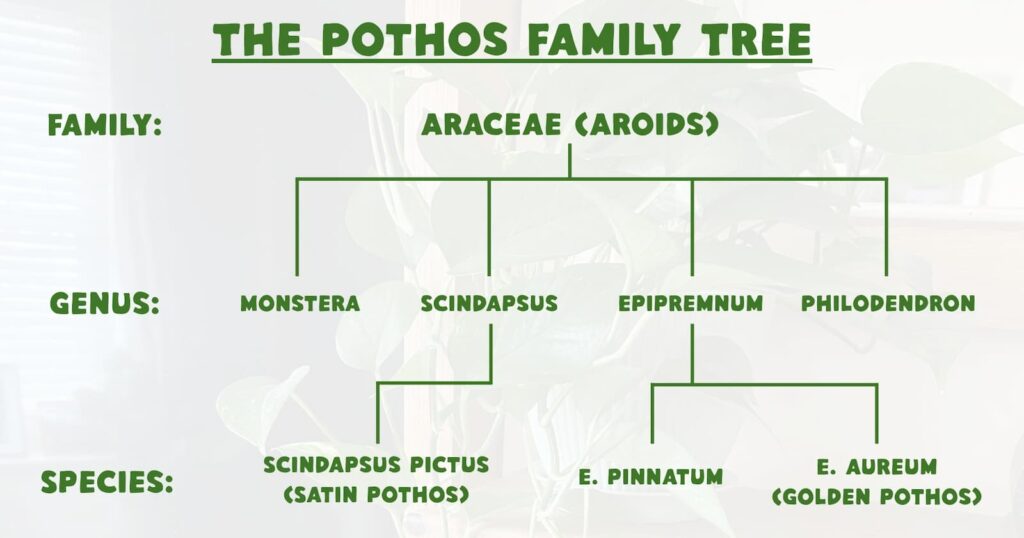
Interestingly, in the early 1900s botanists thought golden pothos belonged in the Scindapsus group too. It was originally called Scindapsus aureum. Over time, we learned more about how pothos grow in the wild. And scientists realised they had made a mistake.
Most pothos cultivars were reassigned to the Epipremnum genus in the 1960s. They took the name pothos with them when they moved. But they left it behind too, in the form of Satin Pothos, who really did belong in the Scindapsus group all along.
Keeping Satin Pothos
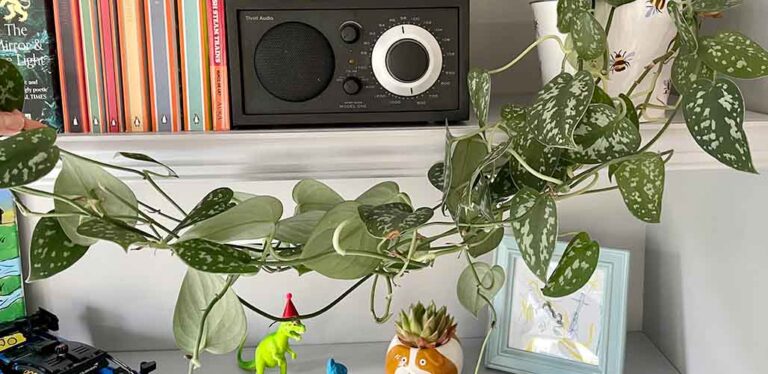
Satin pothos is a very pretty, trailing, plant. It has similar shaped leaves to golden pothos, but they are thicker and more velvety in texture. They are a mid to dark green, spattered generously with silver. Different cultivars have different amounts of silvering. We won’t go into all the options here as this is not a ‘real’ pothos. But I will say – I do really like these pretty plants. They make an eye catching cascade, and are nearly as ‘easy care’ as a golden pothos.
The main difference in my experience is that satin pothos likes to be a bit drier, and is more likely to be harmed by overwatering. If you are a forgetful waterer, this could be the right plant for you!
Which Pothos Variety Is Right For You?
Hopefully, you can see now why I have so many different pothos plants at home – and why I’d like some more. (If so, could you please explain it to my husband, who keeps saying unhelpful things like ‘there’s no more space’ and ‘this isn’t a greenhouse’. Thanks!)
This is a rich and varied family of lush, pretty, plants. They’re relatively easy to care for, provided you are able to offer plenty of diffuse, indirect, light. And they come in a lovely range of colors and styles.
The best pothos variety for you will be the one that matches your home best. If you’re looking for the most plant volume for the least effort, I would get a standard golden pothos, or a Jade, every time. For a splash of bright color, I like Neon. For space saving I would get an N’joy or Pearls and Jade. If you’re looking for dramatic trailing length, I suggest a marble queen, or our cheeky Satin imposter. For height and drama, the fenestrating Cebu Blue is my winner, and for showstopping variegation, my fussy little ‘Happy Leaf’ manjula takes the prize, I think.
The Best Plant For You
The plant that best suits you and your home is a personal choice – there’s no right or wrong – but a healthy plant will almost always look much nicer than an unhealthy one. ‘Easy care’ plants can seem more boring, but will look a lot more fancy than a highly variegated, sunscorched and browning, unhappy, cultivar.
And a word of caution about buying online. I often buy plants online and I’m usually very happy with them. I can personally recommend both Hortology and GrowTropicals here in the UK as always having supplied me happy, healthy, plants. But variegated plants vary! The plant in the picture will not be the plant you are posted. So if your heart is set on a particular pattern, or a certain proportion of green or white on your leaves, do go and choose in person. This is also a good plan if you’re buying a rare or large plant, as these are more expensive, so it’s helpful to be able to assess the health of the plant and check it for pests before bringing it home.
Whatever your next pothos may be, I hope you love it, and it brings you joy. And if you’d like to recommend your favorite pothos variety, please do let us know in the comments below!
References
“Cultural Guidelines for Commercial Production of Interiorscape Epipremnum”. McConnell et al. AskIFAS. University of Florida.
“Marble Queen Epipremnum aureum”. North Carolina Extension Gardener Plant Toolbox.
“Epipremnum aureum plant named ‘Global Green’”. Google Patents.
“Epipremnum plant named ‘njoy’”. Google Patents.
“New Florida Foliage Plant Cultivar: Pothos ‘Pearls and Jade’®”. Henny, Chen, & Mellich. AskIFAS, University of Florida.
“A Plethora of Pothos Varieties”. Costa Farms.
“Satin Pothos”. Poison Control. ASPCA