Getting Started with Golden Pothos; A Guide To Keeping Devil’s Ivy Indoors
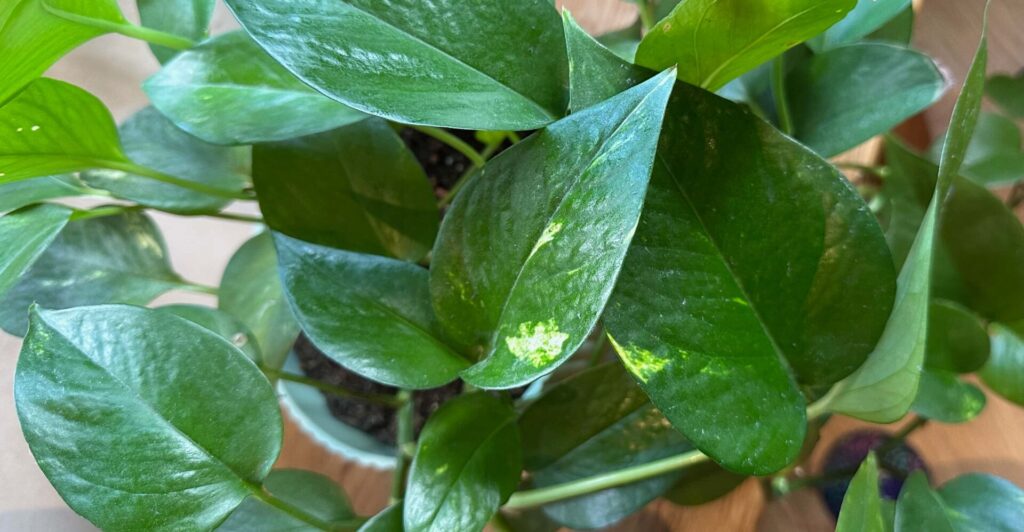
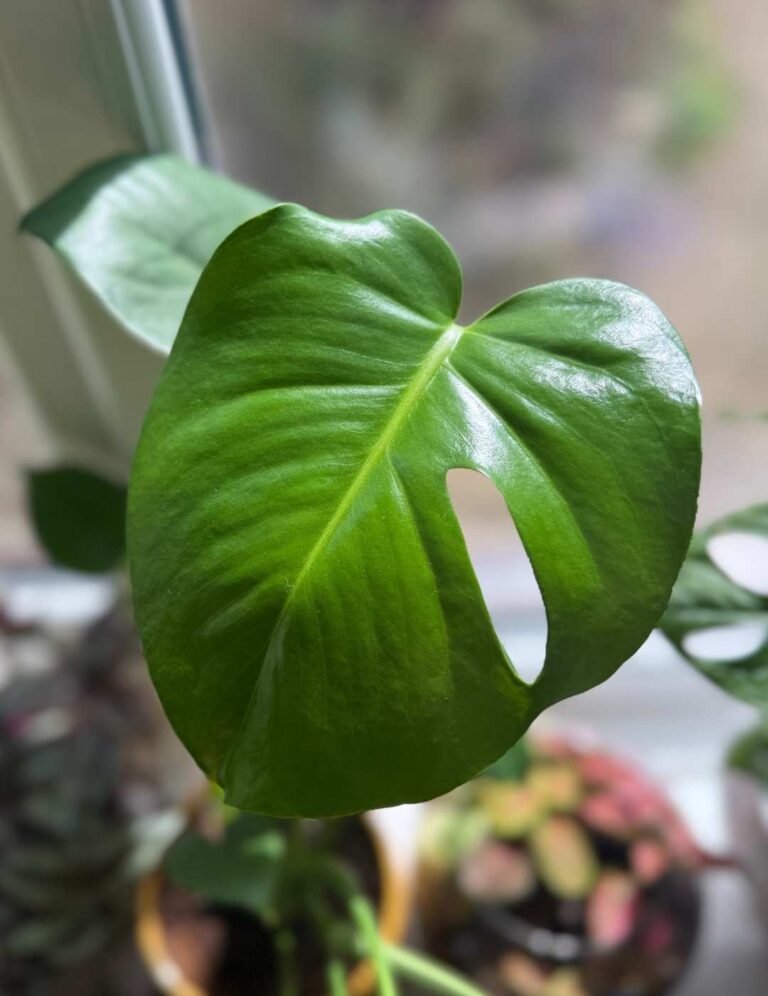
My golden pothos might be my favorite houseplant. It’s incredibly low maintenance, and very forgiving. It has beautiful mid green leaves with just a hint of yellow variegation, that trail in thick clusters over the end of a side table in my living room. It gets more compliments from visitors than the giant monstera in the bay window, grows more vigorously than my philodendrons, and gives me much less hassle than any of my calathea. Oh, and it’s easy to propagate too!
Yes, I’ve decided. It’s my favorite.
Introducing; The Plant That Would Not Die
Golden pothos plants evolved as tropical, vining, evergreen, tree climbers. Their proper name is Epipremnum aurum, and they’re also often known as “Devil’s Ivy”. In warm humid locations they grow vigorously outdoors. So much so that it’s classed as an invasive species in Florida. (So do keep yours in a container if you’re growing it outside in a hot damp region.)
For those of us in cooler climes, golden pothos happily tolerates the drier air and lower light levels indoors. So happily, in fact, that it’s one of the most popular houseplants in North America and Europe.
Pothos looks great, and it’s easy to look after. It isn’t vulnerable to many pests, doesn’t mind if you forget to water it for a few days, isn’t keen on being fed very often, and can be safely ignored a lot of time. Put simply, it’s really hard to kill.
Mine just sits quietly on its side table and grow, and grows…. and grows….
Your First Pothos Plant
Pothos have been sold in commercial nurseries for decades, and are very easy to come by. But if you fancy something a bit special there are also a variety of different ‘cultivars’ of golden pothos that you could choose instead. They have very similar care needs, and tend to be a little less vigorous but still easy to care for, with the added bonus of being a bit more colorful.
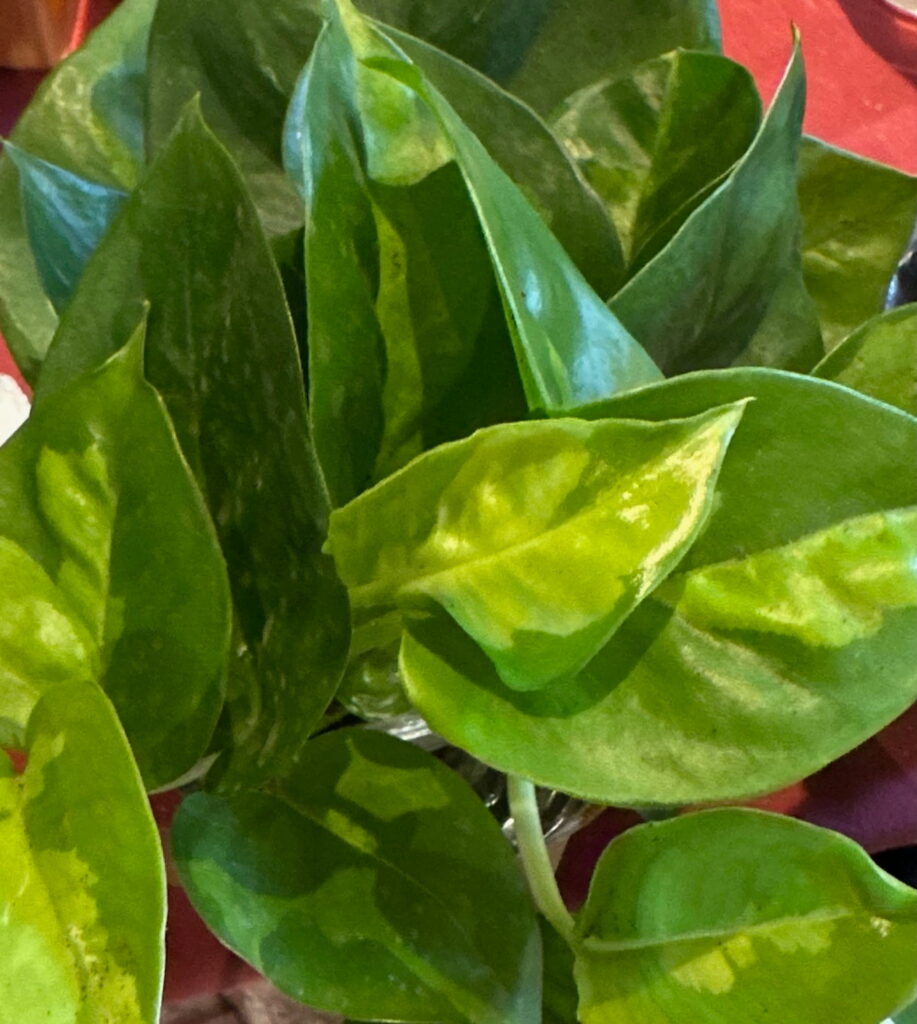
I love my variegated ‘global green’ pothos, which has two bold shades of green on the leaves. ‘Lime’ and ‘neon’ cultivars have a light green leaf, ‘jade’ is dark green. And ‘marble queen’, n’joy, and ‘happy leaf’ pothos plants are all variants of golden pothos with white patches on the leaves. My happy leaf pothos in particular is more white than green on many of the leaves.
Do consider the light levels in your home if you’re thinking of buying a highly variegated plant. Your plant will need a nice bright, indirect, light source to keep its pale leaf pattern. If your intended pothos location has lower light levels, then a standard golden pothos, or golden pothos ‘jade’, are more likely to keep their good looks!
One last quick note when you’re picking your plant. There is another species of Epipremnum that is also known commonly as pothos. Epipremnum pinnatum is a slower growing species with more pointed leaves, that fenestrate. Common examples include Baltic Blue pothos and Cebu Blue pothos. These are also great houseplants, but are not covered in today’s article, which is focused on the ‘aureum’ (golden) species of pothos. If in doubt, just check the label – that’s what it’s there for!
It’s Okay To Start Small
An ordinary golden pothos plant grows fairly fast, so don’t feel under pressure to buy a big expensive plant, unless you really can’t wait. If you have a friend with their own pothos, you can even ask for a cutting or three to propagate in water. You don’t need fancy kit for this – a jam jar will do. Your cutting needs one node, and one or two leaves. Make sure the node is under water, and the leaves are above water. Refresh the water once a week and wait for the roots.
I like to pot my cuttings into soil as soon as they have several roots that are over an inch long, but it won’t hurt them to wait a bit longer. If you have several cuttings, pop them all into the same pot for a fuller look. They’ll be perfectly happy in there together!
The Right Light
Your pothos will forgive you if you pop it in a dimly lit corner. But you’ll get the best out of it if you place it in an area with bright indirect sun. Mine is near a window that has slatted blinds. Bands of light and shade come through – not unlike the light through a jungle canopy. If we didn’t have the blinds I would pop it a little further back from the window. Too much direct light can scorch the leaves.
The more hours of (indirect) light you can give your plant, the faster it will grow, so if you want it to bulk up, try a south or east facing window, or use grow-lights to add some hours of light in the winter. Turn your pot occasionally to get an even shape, or leave it facing one way if you want the leaves to cascade down one side.
I’m Not Thirsty
Every day, I walk around my house carrying a jug of water and poking the soil of all my plants in turn. Any pothos with completely dry soil just under the surface gets a small drink. Most days, most of my pothos don’t need any water at all. At the end of the walkround, I refill my jug, and pop it on the side for the chlorine to dissipate, ready for tomorrow’s round. This keeps them pretty happy!
There’s no chlorine in rainwater. So letting the chlorine from tap water reduce, by standing it out in a jug like this for 24 hours, is often nicer for houseplants. My pothos don’t seem very picky about this, but I have other plants that really hate chlorine (calathea, I’m looking at you!), so using one dechlorinated jug for everyone is easiest anyway.
I then do a second walk around with a spray bottle, and give all my jungle friends, including the pothos, a good misting. Pothos love to be damp, and a number of their pests hate it. So that’s a win win.
If a daily walk round would feel too much, it’s also fine to water pothos roughly every 3 days. I just find it easier to remember if I check daily!
If you underwater your pothos, it will let you know by drooping. A good drink will perk it back up, with no harm done. If you overwater, however, the water can prevent oxygen reaching the roots, leading to root rot, which can kill plants very rapidly.
Be especially careful with small plants or newly transferred propagated stems, in overly large pots. When a pot is nice and full of roots, water is absorbed fast. When the pot is a bit big, the water can end up being left to stand in the soil, making disease more likely.
I’m Not Hungry!
Official advice is to fertilize your golden pothos every other month, and skip winter altogether. But I have fertilized mine just twice in two years, and it’s very happy! To fertilize, I just add a few drops of ‘baby bio for houseplants’ to my usual jug of water when I do the rounds. That’s a tiny amount of fertilizer per plant.
Indoor plants that are watered sparingly don’t get their nutrients washed away like outdoor plants do. Extra nutrients from fertilizer tend to stay in the pot until the plant uses them. Some extra nutrients can be helpful to your pothos when it’s growing rapidly, but too much fertilizer can damage the plant. So fertilize with caution. Less is more.
Patience!
If your plant is a nice healthy color, but just doesn’t seem to be growing much at first, stay patient! Give your new plant a few weeks to settle in, and then have a play with tweaking light levels for it. Slow growth is almost always due to needing more light. Low light can also make your plant more ‘spindly’, as it stretches out long stems between leaves, to try to reach more light.
Cultivars with paler leaves are especially likely to grow slowly in low light levels. Pale leaves have less chlorophyll, and so they trap energy less efficiently. If the light is too low for your variegated pothos, they will let you know by gradually losing their paler regions, and becoming a more solid green. Don’t worry, upping the light levels will bring the variation back!
Just remember you want to up the amount of indirect light. Place your plant in a bright room, a few feet from a window, rather than right up against the glass. Pothos leaves scorch surprisingly easily on the windowsill.
Pets
Because sunny windowsills are also popular with cats, now is a good time to mention that golden pothos is mildly toxic to animals, and people. The leaves contain calcium oxalate crystals – the plant’s defence against herbivores. They can make your cat’s mouth itch, and irritate their digestive system. And that goes for your toddler too!
Pothos is not deadly, and most cats and dogs seem to ignore it for the most part. But it is sensible to pop it out of reach of children and any pets you have that might take a bite. And if your pet does start drooling, vomiting, or showing signs of a sore mouth, check your plant for nibbles, and let the vet know what’s happened.
We have a house rabbit – and she’s not allowed near our pothos. Not just to keep the plants pretty, but because we love her, and don’t want to give her a sore mouth and a stomach ache!
Pests
Of course it’s not just cats and rabbits that may try to eat your pothos! All the usual pest suspects can technically be found on your plant, including aphids, spider mites, and thrips. But on the whole the best defence you can give your plant against these pests is just to keep them healthy.
My golden pothos has so far avoided all three of the nasties above, even when other plants in the same room have caught them. (Here’s hoping I haven’t jinxed it now). In general, a pothos that’s getting the right light, moisture, and nutrition is pretty good at defending itself against pests. There’s a reason we call it ‘the plant that won’t die’!
Pot Up When It Pokes Out
Once it starts to grow, it’s okay to let your golden pothos really fill its container. But if your pothos’ roots have started poking out bottom of the pot, or if it’s getting the same light as before but has stopped putting out new growth, it’s probably time to pot it up!
As a rule of thumb, your pothos is likely to need potting up into a bigger container roughly once every year or two. My two year old plant is in it’s second pot and looks very happy there at the moment.
Your new pot will need drainage holes, to help avoid that trapped water we talked about earlier. I find a plastic nursery pot with plenty of holes, placed on a saucer, or in a decorative waterproof outer pot, works best. Make sure your decorative pot is a size bigger than the nursery pot. If the nursery pot fits too tightly, it’s harder for water that runs out the holes at the bottom to evaporate. Your plant can end up secretly standing in a smelly swamp.
Don’t pot up too fast. Again, this traps too much water in the pot. A pot just an inch wider (1cm more spaces all the way around your plant) is plenty big enough. There are lots of complicated options for potting mixes, but the simplest option is to buy standard houseplant potting mix, and ‘dilute’ it with some perlite. I mix 2 cups of compost with 1 cup of perlite, and stir it together with my fingers. Or give it to my 6 year old to stir, which is even easier!
As long as the roots look healthy, don’t mess about with them too much, just loosen them a little, and gently fill in the new space around them with your potting mix.
Pruning
Last but not least – pruning. Here’s the truth; your golden pothos won’t really mind whether you prune it or not. But pruning will encourage fuller, bushier growth, and just makes it look prettier, in my opinion. Pruning is also a great time to create some new plants, for free!
Start by taking off any dead or browning leaves, as you spot them. This helps reduce pests and keeps the plants energy directed towards healthy leaves. Cut with a clean pair of kitchen scissors, at the base of the leaf, just above the ‘node’ where leaves emerge from the stem. This is also a good time to give any dusty leaves a wipe with a damp cloth, so they can gather more light.
Occasionally trimming the healthy trailing vines too, will help encourage more growth near the base of your plant. Cut with clean scissors just after a node. You can propagate the offcuts, just like we discussed above, and pop them back into the soil with the parent plant when they have roots. Or why not donate your baby plant to a friend, and continue the golden pothos sharing cycle!
References
“Pothos, Epipremnum aureum”. Wisconson Horticulture Divisional Extension, University of Wisconsin-Madison
“Assessment of non-native plants in Florida’s natural areas; Epipremnum aureum”. Institute of Food and Agricutural Sciences. University of Florida.
“How to Grow Pothos Indoors (Epipremnum spp.): Care, Cultivars, and Common Problems”. 2026. College of Agriculture, Forestry and Life Sciences. Clemson University.
“Pothos”. Biosphere 2. University of Arizona.
“Golden Pothos”. Toxic and Non Toxic Plants. ASPCA.