How To Harvest And Store Basil
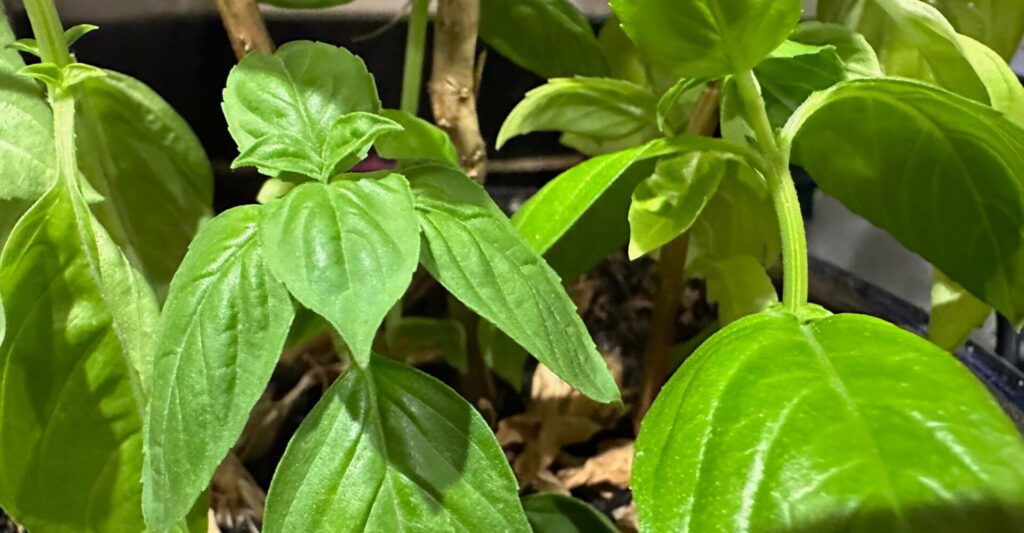
My basil is taking over my kitchen windowsill. It’s now so big that it’s making my kitchen noticeably darker. Which can only mean one thing – it’s time for a proper harvest.
Two Different Harvests
I harvest my basil in two different ways. Continuous ‘as needed’ harvesting for cooking, which doubles as a gentle pruning session. And a major cut back when it starts to take over the room.
Gentle regular pruning will help make your basil plant nice and compact and bushy, and discourage it from getting thin and leggy. I cook with basil a lot, so cutting as needed keeps my main plant in pretty good shape. And if I notice a single shoot making a bid for the ceiling when I don’t have a recipe planned, I just snip it off and pop it in the little propagator rack I keep on the windowsill. Our tray of baby basil plants was a hit on the PTA plant stall at the littlest one’s school fete this summer!
When it’s time to prune my light stealing plant back properly, however, there will be far too much basil cut to just eat there and then. And there’s a limit to how many baby plants I want to grow! So I’ve found it helpful to learn how to store my cuttings, as well as how best to cut them, to keep my plant healthy.
Harvest Time Is Near
If your plant is a brand new baby, do wait for it to be at least 6 inches tall, and have at least 8 adult leaves, before starting to pick! This tends to be at least 4 weeks after starting to grow, if you’ve grown your own from seed or cuttings. Expect to wait 2-3 months before you can do a hard cut back, rather than just taking a sprig here and there. This patience helps the early plant grown strong, and it will pay off. My kitchen window monster was grown from a supermarket cutting this spring!
Once it’s mature enough, basil can be harvested throughout the summer and early autumn months if it’s growing outdoors. And potentially year round, indoors, if you can get it enough light. I rotate my herbs under growlights if they start to look a bit sad in the winter. Not everyone fits, so they have to take turns, but it’s still a huge help and was relatively cheap to set up, so I do recommend a set of lights if you have the space. As long as your plant is putting out new growth, you can continue to harvest for your cooking over the winter.
But if your basil is outdoors, it’s worth thinking about doing a major harvest in September, or perhaps October if you’re in warmer climes. If in doubt, too early is better than too late; all those lovely leaves will be spoiled with the very first frost.
Snip Snip Snip
When you harvest your basil, it’s best to cut a stem, with a pair of clean scissors, just above a pair of leaves. Cutting a stem removes the plant growth hormones in the tip, which triggers new branches to grow from the leaf node just below your cut. Think of yourself as mimicking the grazing action of herbivores browsing on the newest tenderest tips of the plant. Your basil has evolved to survive, and even thrive, when this happens.
Try to resist the temptation to strip off individual leaves by hand. Pinching off single leaves skips the biological hormone trigger that stimulates new growth, making it harder for your plant to replace what you took – or even recognise that it’s gone!
Your plant has also evolved to be great at healing a neat cut. So do take a moment to fetch those clean scissors, and avoid accidentally tearing a strip out of the stem with your grubby gardener’s finger nails.
And remember, your basil plant’s leaves are its energy factories. Leave at least one third of the leaves behind when you harvest, to help your plant have the energy to replace what you took – and to stay healthy.
The Early(ish) Bird Catches The Oil
Basil’s flavor comes in large part from a compound called linalool. Studies show that linalool levels in basil climb in the mornings, peaking by noon, and then drop quite low by evening. For the best flavor, it’s recommended to pick in sunshine, after the dew has dried, but before the real heat of the day hits. So early, but not so early you’ll mind getting up for it.
At work all week? Set an alarm for a weekend morning harvest, for your big cut back, to avoid ending up with bland, evening, basil.
Flowers, Or Flavor
Basil isn’t good at doing two things at the same time. It either makes leaves full of great tasting oil. Or it makes flowers.
If your plant starts to flower, and you want to continue harvesting leaves, start pinching off those flower buds as quickly as they appear! Once the plant is putting much energy into maturing the flowers, oil composition changes in the leaves. The flavor tends to decrease, and the leaves can become quite bitter. Interestingly, some gardeners notice the flavor change more than others. It’s worth nibbling a couple of leaves to see what you think – but if you’re cooking for other, it’s best to check their opinion too before committing to making a giant batch of pesto!
The Last Harvest
If your basil has flowered ‘properly’ you may find your leaves remain bitter for the rest of the season. But, even if you prevent it flowering, basil growing outdoors has a natural end to the year’s harvest.
Signs your plant is done for the year include tough, woody stems, graying leaves, and fewer leaves. Basil hates the cold. Temperatures of 41F (5C) are low enough to seriously damage your plant. And the very first frost can kill your plant completely, overnight. When I grow basil outside, my goal is to get one last big harvest in just before this natural end to the year, which can come quite early here in the UK.
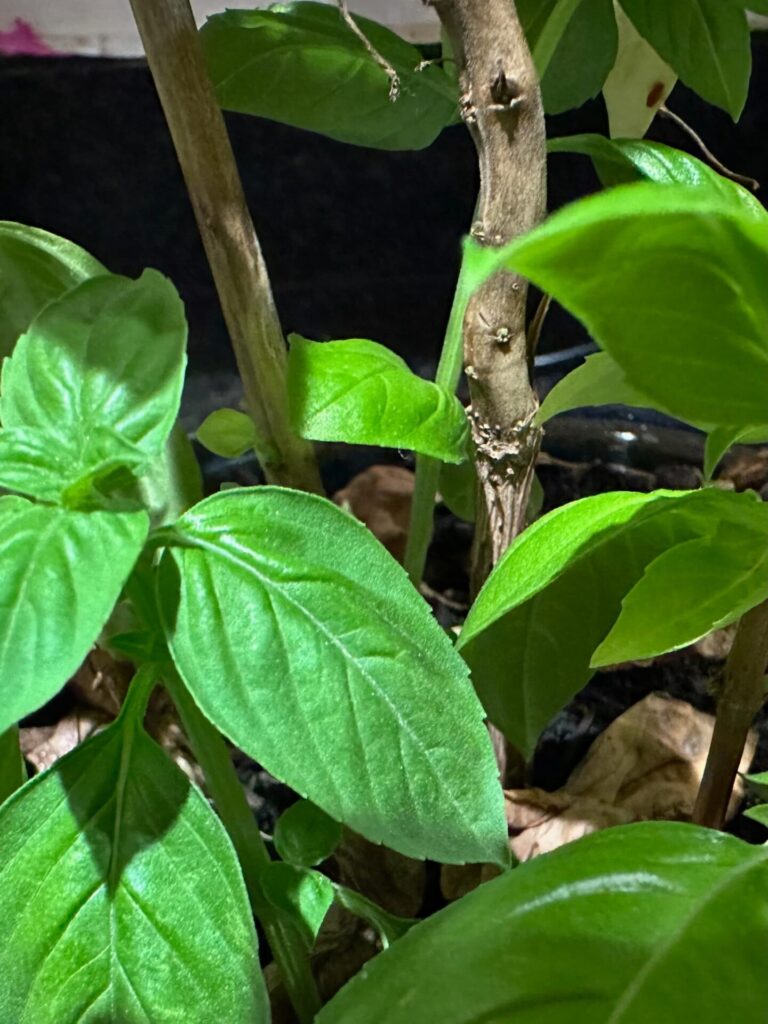
Studies show that basil can suffer ‘chilling damage’ at temperatures as high as 59F (15C). And flavor seems to be affected before there’s any visible leaf damage. So in recent years I’ve ‘cheated’ the system by growing my basil indoors instead. (Another option is to grow your plant in your greenhouse with the tomatoes, which may have a side benefit of protecting the tomatoes too!)
Plants growing indoors do slow down over the winter, but I find my basil still grows enough new leaves to cope with a little gentle harvesting for my winter cooking needs.
Goldilocks and the three basil harvests…..
Basil continues to be picky about the temperature after harvesting too! Traditional ways of drying and storing herbs can upset your basil, costing you flavor, looks, or both. There’s a knack to getting basil preservation just right.
Not too hot….
The traditional way to store basil, like many other herbs, is by drying it. But the key here is to dry at a low, slow, temperature. When we put basil somewhere hot, like a warming oven, to dry it, we evaporate the natural oils that give the leaves their flavor.
This happens to some degree no matter what method of drying we use. Which is why dried basil always has less flavor than fresh basil. But the slower and cooler we dry it, the more flavor we can save. So using a dehydrator, or good old fashioned hanging up to air dry, are what I recommend if you want to dry your basil.
Personally I like to air dry my herbs, if I want to store them in their dry form. If the oils are going to be lost either way, they might as well at least make my house smell nice in the process!
Tie your basil in bundles of 4-6 stems, and hang them out of direct sunlight for a couple of weeks, until the leaves are crispy. Avoid humid places like the bathroom, or over the kitchen hob top. When they are completely dry, crush the leaves, discarding the stems, and place them in an air tight jar. I like to use a small Kilner jar (the British equivalent of a Mason jar) because they have a great seal, they’re strong, I can see what’s inside, and glass is recommended for storing herbs. And they’re pretty.
But my husband just uses the first screw top jam jar that comes to hand in the cupboard (we are jam jar hoarders). And his herbs always taste fine, too!
Do label your jar. Dried crushed herbs all look the same. I used to use a china graph pencil so I could wipe the jar clean when I was done. But teenagers hunting through the herbs and spices for ingredients do not handle labelled jars carefully, and many a herb has become anonymous over the years. So I now use a sharpie. (Top tip: nail polish remover will get the marker pen off when you want to use the jar for something else)
Not too cold….
Remember how we said basil is damaged by temperatures under 41F (5C)? Resist the temptation to pop in in the fridge to use tomorrow. It won’t do well in there!
Refrigerated basil wilts and gets brown spots at best, and goes black and decays at worst. If you have some cut basil that you want to use in the next day or so, wrap them in a damp paper towel, or damp tea towel (dish towel) if you have a paper-towel-free home like mine. Then pop the wrapped basil into an airtight container. This doesn’t have to be anything fancy – an Ikea sandwich pot dug out from the back of the larder is my go to! Leave your container at room temperature, and don’t wait too long to use it.
Alternatively, if you’ve got long cut stems, you can stand them in a glass of water for a day or so. But don’t wait any longer to use it, unless you want it to start putting out roots!
Just right… which is actually very cold….
Basil hates the cold. The fridge turns it black, frost kills the plant almost instantly. So it seems logical to avoid freezing it too. And it’s true that if you put fresh basil leaves straight into the freezer, they will be spoiled. But the very best way to preserve basil with most of it’s flavor is to freeze it. It’s just important HOW you freeze it, if you want nice green basil to use later.
There is a specific enzyme in basil that turns the leaves brown and black when they are too cold. That enzyme is similar to the one that turns cut apples brown. It works by reacting with oxygen. So we can trick our basil into surviving the cold without browning, by cutting off the oxygen supply.
To freeze nice green basil, first give your harvest a wash and carefully dry it with a salad spinner, dish towel, or paper towel. Then drizzle a little olive oil in the bottom of a clean, dry, ice cube tray. You don’t need to use every available cube – I tend to focus on getting as many as possible about three quarters full.
Dice your basil and place the cut pieces in the tray, pressing them down gently and adding another drizzle of oil a couple of times as you go, until the cubes more than half full. Top up with olive oil until your cut leaves are covered. Pop the tray in the freezer overnight, and then you can pop the solid cubes out into a freezer bag (or I use an old ice-cream tub) to free up your ice cube tray.
To use, just drop a frozen basil cube directly into your pan, and heat along with the rest of your ingredients!
If you prefer whole leaves, the same method works for these two, you just need a larger freezer container to put them and the oil in! And of course, there is another way to freeze your basil, too…
Hey, Pesto!
Here’s my secret. I can’t bear the taste of pine nuts. And that means that, even through I love basil, and garlic, and parmesan….for many years I never ate pesto, and I missed out on the easiest pasta dish going!
Pesto deserves a mention here, though. Because you can batch prep it, and freeze it, much like the diced leaves above. But when you defrost it, it’s instant pasta topping! (And, it turns out, you don’t need to use pine nuts in the prep if you don’t want to. I probably should have realised this a lot sooner…)
Pesto is typically made by blending finely chopped basil, pine nuts (or almonds or walnuts!), garlic, hard cheese, olive oil, and seasoning. There are lots of varieties on this theme and I encourage any keen basil grower to try a few, and find their favorite. Because, once you have a favorite, you can batch prep it when you do your big basil harvest, pop it into ice cube trays, and freeze it for perfect easy last minute meals. Just like the basil in oil above, pop it out once it’s solid and store the cubes of pesto loose in a suitable freezer container. Using small cubes like this lets me grab the right number of cubes for the people eating, too. Perfect in a big family with lots of teenagers coming and going!
Bountiful Basil
Basil is such a forgiving plant (except about temperature), that harvesting it really is as simple as taking what you need when you need it, and stripping a big harvest off if it gets out of control, and before the cold weather. It’s a bit more fiddly to store, but just remember to dry it slowly, and keep it at room temperature unless it’s under oil, and you’ll be just fine.
Wishing you a generous harvest, and many frozen tasty cubes to tide you over the winter!
References
- “Ultra-Niche Crops Series: Fresh-Market Basil”. Cooperative Extension Fact Sheet FS1279. Matthews, J. et al. New Jersey Agricultural Experiment Station. Rutgers.
- “Growing basil in home gardens”. University of Minnesota Extension
- “How to induce defense responses in wild plant populations? Using bilberry (Vaccinium myrtillus) as example”. Seldal et al. 2017. Ecology and Evolution.
- “Plant Hormones”. The Science of Plants. 2022. University of Minnesota Department of Horticultural Science.
- “Day-time variations in essential oil contents of sweet basil (Ocimum basilicum L.) ecotypes in semi-arid climatic conditions”. Suleyman et al. 2025. Annals of the Brazilian Academy of Sciences.
- “Phytochemical compositions and antioxidant activity of green and purple basils altered by light intensity and harvesting time”. Eskandarzade et al. 2024. Heliyon.
- “Essential Oil Composition and Antioxidant and Antifungal Activities of Two Varieties of Ocimum basilicum L. (Lamiaceae) at Two Phenological Stages”. Mounira et al. 2022. Agronomy.
- “Chilling temperatures and controlled atmospheres alter key volatile compounds implicated in basil aroma and flavor”. Rodeo & Mitcham. 2023. Frontiers in Plant Science.
- “Screening Basil cultivars and landraces for cold tolerance using physiological and biochemical markers”. Pouyesh et al. 2025. South African Journal of Botany.
- “Effects of different drying processes on the quality changes in Arapgir purple basil (Ocimum basilicum L.) leaves and drying-induced changes in bioactive and volatile compounds and essential oils”. Altay et al. 2024. Journal of Food Science.
- “Preharvest and postharvest techniques that optimize the shelf life of fresh basil (Ocimum basilicum L.): a review”. Brindisi & Simon. 2023. Frontiers in Plant Science.
- “Enzymatic browning: The role of substrates in polyphenol oxidase mediated browning”. Tilley et al. 2023. Current Research in Food Science.
13. “Basil chilling injury: Oxidative stress or energy depletion?”. Larsen et al. 2025. Food Chemistry.